

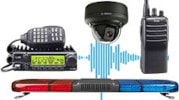
Icom IP WIFI Two-Way Transceiver Radio
The Icom IP Wi-Fi two-way radio provides voice and text communication over WLAN and IP networks. The system supports simplex and full-duplex operation, individual, group, talkgroup, all-call and telephone calls, while the communication area can be extended with wireless access points and IP networking. The handheld radio supports IEEE 802.11 a/b/g/n/ac standards, while the system can be expanded with a controller, dispatcher application, access point, RoIP gateway and VPN router. Read more...

• Transceiver radio on Wifi network
• Provides instant communication with group members
• IEEE 802.11 a/b/g/n/ac
• WEP (64/128-bit), WPA2-Enterprise, WPA-Enterprise, WPA-PSK, WPA2-PSK network encryption
• 10mW RF output power
• 1000mW audio power with internal speaker
• Individual, group or all member station calling and messaging
• No monthly frequency fee or other charges
• 20 or 100 users on a network, depending on the controller
• Full-duplex communication using headset
• IP1000C network controller required for system operation
• No extra infrastructure costs for existing WiFi coverage
• Built-in Bluetooth functionality with HFP. HSP profile
Special gross price: 340.51€ (Net price: 268.12€)


• Dispatcher software for IP100H radio and IP1000C controller
• Localization of IP100H radios with the use of access points
• Shows the status of IP100H radios
• Personalised call buttons
• Shows the received and sent text messages
• Works on Windows operation system
• Supplied USB hardware key
Special gross price: 488.54€ (Net price: 384.68€)

• IPsec tunnels: Up to 32
• Encryption: 3DES, AES-128, AES-192, AES-256
• Authentication: MD5, SHA-1
• IKE keying method: Pre-shared Key
• NAT traversal: Supported
• Multicast protocol: Supported (VE-PG3 and VE-PG2 only)
• WAN interface: Two 10BASE-T/100BASE-TX/1000BASE-T ports (RJ-45 connectors, Auto MDI/MDI-X)
• LAN interface: Four 10BASE-T/100BASE-TX/1000BASE-T ports with switching hub
• USB interface: Two USB(2.0) ports
• Maintenance console: One RS-232C (RJ-11) connector


• Power supply: PoE (IEEE 802.3af standard: Max. 9 W)
• Security standards: WEP (64/128/152 bit), WPA, WPA2, WPA-PSK, WPA2-PSK, IEEE 802.1X/EAP
• Cable LAN: 10BASE-T/100BASE-TX/1000BASE-T compatible RJ-45 type connector (MDI/MDI-X auto-discrimination) × 1
• Cable LAN data rate: 10/100/1000 Mbps
• Wireless LAN data rate: 11/54/400* /867 Mbps * When connected to a 256-QAM compatible terminal
• Dimensions: 162 mm width x 162 mm depth x 42 mm height
• Weight: 520 g

• System controller for IP110H/IP100H wireless LAN radios
• Up to 300 WLAN radios can be registered
• VPN function
• Rack-mountable design (with optional MBF-6 frame)
• Power supply requirement: 12 V DC ±10% Less than 33 Watts
• Usable envirement: Temperature 0 to +40°C; +32 to +104°F
• Dimensions: 213 (W) × 36.8 (H) × 242 (D) mm
• Weight: 1.5 kg
• WAN/LAN: RJ-45 connector × 1, 2.5GBASE-T/1000BASE-T/100BASE-TX (Auto MDI/MDI-X)
Icom IP Wi-Fi two-way radio for WLAN-based communication
The Icom IP radio transmits voice and data over a wireless LAN infrastructure instead of a conventional radio-frequency network. Communication passes through WLAN access points to the IP network and system controller. The WLAN radio uses standard wireless LAN frequencies, so no separate radio-frequency licence or dedicated radio repeater is required. The communication area can be defined by the placement of access points connected to the network.
How does IP-based radio communication work over a Wi-Fi network?
In IP-based radio communication, the handheld terminal connects to a WLAN access point, while voice and text data are transferred through the IP network to the system controller and destination terminals. Communication between transmitting and receiving devices is managed by the controller. Due to the WLAN network architecture, other terminals can initiate or receive separate communications while one radio is transmitting.
IEEE 802.11 WLAN communication on the Icom Wi-Fi two-way radio
The handheld WLAN radio supports IEEE 802.11 a/b/g/n/ac standards. Documented network security options include WEP 64/128 bit, WPA-Enterprise, WPA2-Enterprise, WPA-PSK and WPA2-PSK. The Icom access point supports 2.4 GHz and 5 GHz operation, IEEE 802.11ac Wave 2 and theoretical wireless data rates of up to 867 Mbps. The access point also provides Beam Forming, MU-MIMO and virtual AP functions.
Which call types and full-duplex functions does the Icom IP radio support?
The Icom IP radio supports both simplex and full-duplex communication. In full-duplex mode, users can transmit and receive audio simultaneously, similarly to a telephone conversation. The system supports all calls, group calls, talkgroup calls, individual calls and telephone calls. The TalkListen function can be used with or without an external headset. The radio also supports text messaging, while available messaging and status functions depend on the controller configuration.
Icom wireless communication system with controller and access points
The system controller manages terminal configuration and voice traffic. The IP1100CV supports registration of up to 300 WLAN radios and dispatcher terminals and includes VPN functionality, 2.5GBASE-T/1000BASE-T/100BASE-TX network interfaces and optional 19-inch rack installation. Configuration can be performed through a web browser, while settings can be exported to and restored from USB storage.
How can WLAN communication be extended across multiple buildings or sites?
The communication area can be expanded by connecting additional WLAN access points to the IP network. Separate sites can be linked through an internet VPN connection. The built-in VPN function of the IP1100CV can be used to connect multiple system controllers, while a separate VPN router supports up to 32 IPsec VPN tunnels. The router also includes 1000BASE-T Ethernet interfaces and IP multicast routing.
Dispatcher communication and access-point-based location information
The IP100FS dispatcher application can be used on a Windows-based computer or tablet to communicate with IP terminals. The dispatcher can initiate individual, group and other supported calls, display terminal status, and manage transmitted and received call information and text messages. The system can also indicate the position of a handheld radio based on the wireless access point to which the terminal is connected.
Which Bluetooth, IP67 and safety functions are available on the Icom IP radio?
The handheld Icom WLAN radio has an IP67 dust- and water-resistant design. Its built-in Bluetooth function supports HFP and HSP profiles and can be used with an optional Bluetooth headset. The device also supports motion- and position-related detection, Man Down and Lone Worker functions, vibration call alert and Over-the-Air programming. The radio measures 57 x 96.9 x 25.1 mm and weighs approximately 146 g.
VPN, IP multicast and RoIP system integration
The VE-PG4 RoIP gateway combines RoIP, SIP gateway, IP router, IP PBX and IP communication terminal controller functions in one device. It can connect IP transceivers, WLAN radios and conventional radio systems. Its built-in WLAN radio controller supports up to 50 WLAN terminals. Communication audio can be recorded to external USB storage, and the device also supports IPsec-based VPN connectivity.
How should access points and network components be selected for an Icom WLAN system?
When selecting an access point, the required 2.4 or 5 GHz coverage, number of connected terminals and wired network infrastructure should be considered. The AP-95M supports IEEE 802.11ac Wave 2, Beam Forming, MU-MIMO, PoE power, 1000BASE-T Ethernet, IEEE 802.1X/WPA/WPA2 authentication and configuration of up to eight virtual WLAN terminal groups. Automatic channel selection and transmit power level adjustment are also documented functions.
Icom IP radio battery life, audio output and USB Type-C charging
The handheld radio has a documented internal speaker output of 1000 mW. Battery operating time is more than 20 hours using a 1:1:8 transmit, receive and standby duty cycle. Charging time with the specified chargers is approximately 4 hours, and the battery can also be charged using a USB Type-C cable. The radio operates with 10 mW RF output power on the WLAN network.
What are the advantages and limitations of the Icom IP Wi-Fi radio system?
- Advantage: simplex and full-duplex PTT communication over WLAN and IP networks.
- Advantage: individual, group, talkgroup, all-call and telephone calls, together with text messaging.
- Advantage: multiple network areas or sites can be connected using access points and VPN links.
- Advantage: a controller, dispatcher application and RoIP gateway can be integrated into the system.
- Limitation: radio communication depends on the availability of suitable WLAN and IP network infrastructure.
- Limitation: some call, status, messaging and system integration functions depend on the controller and system configuration being used.
When designing the system, the number of terminals, WLAN coverage, number of sites, dispatcher functions and any required connection to conventional radio systems should therefore be defined together.
How can the Icom wireless communication system be used with a dispatcher?
The PC-based dispatcher terminal operates within the same IP communication system as the WLAN handheld radios. The software allows the dispatcher to call radio terminals, manage call information, send and receive messages and display terminal status. Access-point-based location information can also indicate which WLAN coverage area a terminal is currently connected to.
What are the most common questions about Icom IP Wi-Fi two-way radios?
- Is a radio licence required to use an Icom WLAN radio?
The WLAN radio uses standard wireless LAN frequencies, so no separate radio-frequency licence is required for operation of the system. - Is full-duplex communication possible?
Yes. The system supports both simplex and full-duplex operation, while TalkListen provides simultaneous transmission and reception. - Can it be used across multiple sites?
Yes. WLAN radio systems at separate locations can be connected through internet-based VPN links. - How many terminals can the system controller manage?
The IP1100CV system controller supports registration of up to 300 WLAN radios and dispatcher terminals. - Are Bluetooth and USB Type-C charging available?
Yes. The handheld radio supports Bluetooth HFP/HSP, and its battery can also be charged through a USB Type-C cable. - Can conventional radio systems be connected?
Yes. The VE-PG4 RoIP gateway supports integration of IP, WLAN and conventional radio systems.
The exact system components required depend on the number of WLAN terminals, access points, sites and dispatcher stations to be managed.
Summary for designing an Icom IP Wi-Fi radio system
We recommend starting the design of an Icom IP Wi-Fi two-way radio system by determining the available WLAN coverage and the required number of terminals. The appropriate system controller, 2.4 or 5 GHz access point infrastructure, dispatcher application and, if required, VPN router and RoIP gateway can then be selected. On the handheld terminal side, documented functions include full-duplex communication, IP67 protection, Bluetooth, Man Down, Lone Worker, more than 20 hours of battery operation and USB Type-C charging.