

Sirio Marine Antenna
The Sirio marine antenna category includes both CB 27 MHz and VHF models. The documented range covers a 26-28 MHz CB antenna as well as VHF marine antennas operating around 156-163 MHz. Common characteristics of the documented models include vertical polarization and omnidirectional radiation, while frequency range, mechanical construction, connection, cabling and mounting vary by model. Selection within the category should therefore primarily be based on the operating frequency of the radio and the documented technical parameters of the antenna. Read more...
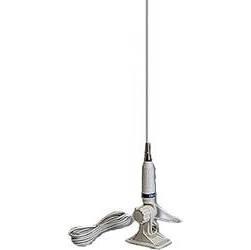
• Type: 1/2 λ
• Frequency range: 156 - 162.6 MHz @ SWR ≤2
• Impedance: 50Ω
• Radiation (H-plane): 360° omnidirectional
• Radiation (E-plane): beamwidth @ -3 dB= 60°
• Radiation anlge deg.: 23°
• Polarization: linear vertical
• Gain: 0 dBd - 2.15 dBi
• Max. Power (CW) @ 30°C: 100 Watts
• Grounding protection: All metal part are DC-grounded, the inner conductor is coupled capacitively
• Cable Length / Type: 5.5 m / white RG 58 C/U
• Standard mount: "M-8" NY


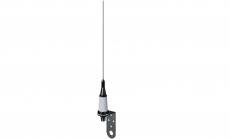
• Type: 1/2 λ
• Frequency range: 156 - 162 MHz @ SWR ≤1.5
• Impedance: 50Ω
• Radiation (H-plane): 360° omnidirectional
• Radiation (E-plane): beamwidth @ -3 dB= 60°
• Radiation anlge deg.: 23°
• Polarization: linear vertical
• Gain: 0 dBd - 2.15 dBi
• Max. Power (CW) @ 30°C: 100 Watts
• Grounding protection: All metal part are DC-grounded, the inner conductor is coupled capacitively
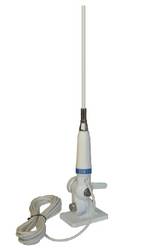
• Type: Base loaded
• Frequency range: 26-28 MHz No tuning required
• Systems: CB 27MHz
• Radiation: Omnidirectional
• Polarization: Linear vertical
• Bandwidth: ≥ 5.6MHz @ SWR ≤ 2
• Max Power: 15 Watts (CW) continuous; 50 Watts (CW) short time
• Grounding protection: DC-Ground
• Cable lenght / type: 5 m / White RG58
• Materials: Chromed brass, Fiberglass, Nylon
• Height (approx): 1505 mm
• Weight (approx): 720 g
• Mounting type: Thru-Holes
• Connector: Not supplied
Sirio marine antenna: CB and VHF solutions for vessels
The Sirio marine antenna range includes versions designed for different radio systems. The Cruiser 2000 CB marine antenna operates in the 26-28 MHz frequency range, with 50 ohm unbalanced impedance, omnidirectional radiation and vertical polarization. Its maximum power is 50 W, its height is approximately 1505 mm and its weight is approximately 720 g.
The Cruiser VHF is designed for the 156-163 MHz range, with a 1/2 lambda electrical configuration and 50 ohm unbalanced impedance. Its H-plane radiation pattern is 360-degree omnidirectional, while polarization is vertical. Maximum power is 100 W, with a gain of 0 dBd or 2.14 dBi. The VHF marine antenna is approximately 1100 mm high and weighs 680 g.
The SB 2 S metal marine antenna has a transmit frequency range of 156-157.425 MHz and a receive frequency range of 156-162 MHz. Its configuration is 1/2 lambda, base loaded, with 50 ohm impedance and a 360-degree omnidirectional H-plane radiation pattern. Maximum power is 100 W CW at 30 degrees Celsius, while gain is 0 dBd or 2.15 dBi.
What frequency ranges can Sirio marine antennas be used in?
CB and VHF marine antennas are designed for different frequency bands. The Cruiser 2000 operates between 26 and 28 MHz and does not require frequency tuning within this range. Its bandwidth is 5.5 MHz at V.S.W.R. 2:1, while the specified V.S.W.R. at the resonant frequency is no more than 1.2:1. The feeding system uses a transformer DC-Ground configuration at the base.
The Cruiser VHF operates between 156 and 163 MHz and likewise does not require tuning within this frequency range. Its bandwidth is 8.6 MHz at V.S.W.R. 2:1, while V.S.W.R. at the resonant frequency is no more than 1.3:1. The E-plane -3 dB beamwidth is 60 degrees, with a radiation angle of 23 degrees.
For the SB 2 S, separate transmit and receive ranges are specified. The transmit band is 156-157.425 MHz with a maximum SWR of 1.5, while the receive band is 156-162 MHz. Its E-plane -3 dB beamwidth is 60 degrees, the radiation angle is 23 degrees and the polarization is linear vertical.
Technical characteristics and construction of VHF marine antennas
The Cruiser VHF uses a fiberglass radiator. Its listed materials include chromed brass, nylon and fiberglass. The antenna has a DC-grounded radiator and operates without a ground plane. Its standard mount is M-8 NY, and it is supplied with 5.5 m of white RG58 C/U coaxial cable.
The mechanical design of the SB 2 S is different. Its radiator is a metal whip, with materials including 17/7 PH stainless steel and chromed brass. Its height is approximately 1040 mm and its weight is approximately 330 g. Its standard mount is M-1, and its connector is UHF-Female. All metal parts are DC-grounded, while the inner conductor is capacitively coupled.
- Cruiser VHF: 156-163 MHz, 100 W, 0 dBd or 2.14 dBi, approximately 1100 mm, 680 g.
- SB 2 S: TX 156-157.425 MHz, RX 156-162 MHz, 100 W CW, 0 dBd or 2.15 dBi, approximately 1040 mm, 330 g.
- Both documented VHF versions have 50 ohm impedance and vertical polarization.
The VHF marine antenna models can therefore be compared directly based on frequency range, power handling, gain, dimensions, weight, connection and mounting.
What should be considered when choosing a marine radio antenna?
One of the main differences between the documented Sirio marine antennas is the operating frequency range. The Cruiser 2000 is designed for 26-28 MHz, the Cruiser VHF for 156-163 MHz, while the SB 2 S is designed for 156-157.425 MHz transmission and 156-162 MHz reception. Maximum power also varies by model: the Cruiser 2000 is rated at 50 W, the Cruiser VHF at 100 W, and the SB 2 S at 100 W CW at 30 degrees Celsius.
Mechanical parameters also differ. The Cruiser 2000 is approximately 1505 mm high and weighs 720 g, the Cruiser VHF is approximately 1100 mm high and weighs 680 g, while the SB 2 S is approximately 1040 mm high and weighs 330 g. The Cruiser models use the M-8 NY standard mount, while the SB 2 S uses the M-1 mount.
Pros: the Cruiser 2000 and Cruiser VHF do not require frequency tuning within their specified operating frequency ranges. Both Cruiser versions use a construction that operates without a ground plane and have a DC-grounded radiator.
Cons: frequency range, mounting, cabling, connector, dimensions and maximum power are not identical across the models, so these parameters must be considered separately for each version.
Coaxial cable, impedance and marine antenna mounting
The Cruiser 2000 is supplied with 5 m of white RG58 C/U cable. Specified cable lengths between the transceiver and the antenna are 4 m, 5 m, 7 m, 9 m and 14 m. The Cruiser VHF is supplied with 5.5 m of white RG58 C/U coaxial cable, with specified cable lengths of 5.5 m, 7.5 m and 11 m.
For the Cruiser antennas, M-3 OT, M-8 NY and M-10 OT adjustable marine mounts are listed. The M-8 NY is made from white nylon and uses a standard 1 x 14 threaded connection, a rubber gasket and stainless steel screws. The M-3 OT is made from chromed brass and also uses a 1 x 14 thread, rubber gasket and stainless steel screws.
The M-10 OT is also an adjustable marine mount, made from chromed brass. It uses a standard 1 x 14 threaded connection and stainless steel fixing screws. The Cruiser 2000 and Cruiser VHF both have 50 ohm unbalanced impedance.
How can Sirio Marine antenna versions differ from one another?
Sirio Marine antenna models can differ not only in frequency band but also in radiator material, mechanical dimensions, weight, mounting, cable configuration and connector type. The Cruiser 2000 and Cruiser VHF use RG58 C/U cable, while the SB 2 S uses a UHF-Female connector.
The construction materials of the Cruiser 2000 include chromed brass, nylon and fiberglass. Its metal components are made from chromed brass and stainless steel. The Cruiser VHF uses chromed brass, nylon and fiberglass. The SB 2 S has a metal whip and uses 17/7 PH stainless steel and chromed brass.
When selecting a marine communication antenna, the documented parameters that can be compared include the 26-28 MHz CB or approximately 156 MHz VHF frequency range, 50 or 100 W maximum power, mounting type, connector, coaxial cable and mechanical dimensions of the antenna.
Frequently asked questions about Sirio marine antennas
- What frequency does the Sirio Cruiser 2000 CB marine antenna operate on?
Its frequency range is 26-28 MHz, and the model is designed for CB 27 MHz use. - What is the frequency range of the Sirio Cruiser VHF marine antenna?
The documented frequency range is 156-163 MHz. - What frequency range does the Sirio SB 2 S operate in?
The transmit frequency range is 156-157.425 MHz, while the receive range is 156-162 MHz. - What is the maximum power of the VHF marine antennas?
The Cruiser VHF has a maximum power of 100 W, while the SB 2 S is rated at 100 W CW at 30 degrees Celsius. - Do the Cruiser marine antennas require tuning?
The Cruiser 2000 and Cruiser VHF do not require frequency tuning within their specified operating frequency ranges. - What impedance do these Sirio marine antennas have?
The Cruiser 2000, Cruiser VHF and SB 2 S all have 50 ohm impedance. - What coaxial cable is used with the Cruiser models?
The Cruiser 2000 uses 5 m of white RG58 C/U cable, while the Cruiser VHF uses 5.5 m of white RG58 C/U cable.
Within the category, CB and VHF marine antenna models can be compared using their frequency range, power, impedance, dimensions, mounting, cabling and connector data.
Summary
The Sirio marine antenna category includes CB and VHF versions. The Cruiser 2000 is a 26-28 MHz CB model, the Cruiser VHF is a 156-163 MHz VHF version, while the SB 2 S has a transmit range of 156-157.425 MHz and a receive range of 156-162 MHz. The documented models have 50 ohm impedance and vertical polarization, while power, gain, cabling, mounting, connection, dimensions and weight vary between models.
We recommend that you first compare the operating frequency range of your radio with the frequency specifications of the selected Sirio marine antenna, then check the mounting, connection, cabling and mechanical dimensions. This allows the CB and VHF marine antenna versions in the category to be compared directly on the basis of documented technical parameters.