

Diamond Base Station Multiband Antenna
The Diamond multiband base station antenna category includes fixed-installation antennas designed for VHF, UHF, and multiple amateur radio frequency bands. The range includes dual-band 144/430 MHz antennas, triple-band 50/144/430 MHz and 144/430/1200 MHz configurations, as well as wideband receiving antennas and Super Discone designs. Documented antenna gain varies according to frequency and construction, reaching up to 13.7 dB in some triple-band configurations. Maximum power ratings range from 60 W to 350 W, while available connectors include N female, UHF female, and Amphenol male. Read more...
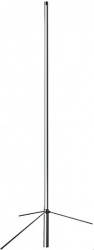
• Receiving frequency: 120/300 MHz
• Type: 5/8λ (120 MHz), 2x5/8λ (300 MHz)
• Gain: 2.15 dBi (120 MHz), 5.5 dBi (300MHz)
• Impedance: 50 Ω
• Wind velocity: 60 m/sec
• Length: 1.7 m
• Weight:1 kg
• Mast diameter: 30-62 mm
• Connector: UHF female (MJ)

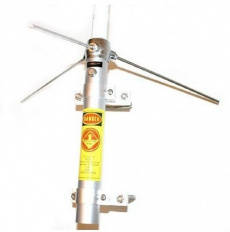
• Type: 1/2 wave (144MHz), 2x5/8 wave (430MHz), FRP outershell
• Frequency: 144/430 MHz
• Gain: 3.0dB(144MHz), 5.5dB(430MHz)
• Power: 150 Watts
• Impedance: 50 Ohms
• VSWR : 1.5:1 (nominal)
• Rated wind velocity: 60 m/sec
• Mast diameter accepted: 30-62 mm
• Length: 1.3 m
• Radial length: 19 cm
• Weight: 0.8 kg
• Connector: N-female
• Type: 6/8 wave C-load (144MHz), 3x5/8 wave C-load (430MHz), FRP outershell
• Frequency: 144/430 MHz
• Gain: 4.5dB(144MHz), 7.2dB(430MHz)
• Power: 200 Watts
• Impedance: 50 Ohms
• VSWR : 1.5:1
• Rated wind velocity: 60 m/sec
• Mast diameter accepted: 30-62 mm
• Length: 1.7 m
• Radial length: 19 cm
• Weight: 0.9 kg
• Connector: N-female

• Type: 2x5/8 wave (144MHz), 4x5/8 wave (430MHz), FRP outershell
• Frequency: 144/430 MHz
• Gain: 6.0dB(144MHz), 8.0dB(430MHz)
• Power: 200 Watts
• Impedance: 50 Ohms
• VSWR : 1.5:1
• Rated wind velocity: 50 m/sec
• Mast diameter accepted: 30-62 mm
• Length: 2.5 m
• Radial length: 52 cm
• Weight: 1.2 kg
• Connector: N-female
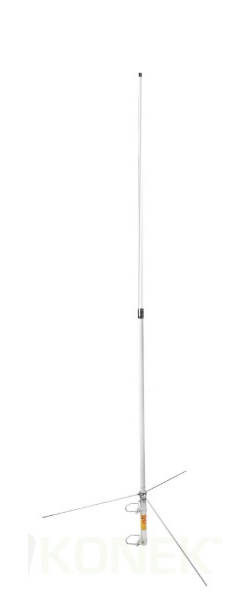
• Type: 2x5/8 wave C-load (144MHz), 5x5/8 wave C-load (430MHz), FRP outershell
• Frequency: 144/430 MHz
• Gain: 6.5dB(144MHz), 9.0dB(430MHz)
• Power: 200 Watts
• Impedance: 50 Ohms
• VSWR : 1.5:1
• Rated wind velocity: 50 m/sec
• Mast diameter accepted: 30-62 mm
• Length: 3.1 m
• Radial length: 52 cm
• Weight: 1.5 kg
• Connector: N-female
• Type: 3x5/8 wave C-load (144MHz), 8x5/8 wave C-load (430MHz), FRP outershell
• Frequency: 144/430 MHz
• Gain: 8.3dB(144MHz), 11.7dB(430MHz)
• Power: 200 Watts
• Impedance: 50 Ohms
• VSWR : 1.5:1
• Rated wind velocity: 40 m/sec
• Mast diameter accepted: 30-62 mm
• Length: 5.2 m
• Radial length: 52 cm
• Weight: 2.0 kg
• Connector: N-female
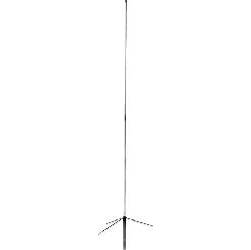
• Type: 4x5/8 wave C-load (144MHz), 11x5/8 wave C-load (430MHz), FRP outershell
• Frequency: 144/430 MHz
• Gain: 9.3dB(144MHz), 13.0dB(430MHz)
• Power: 200 Watts
• Impedance: 50 Ohms
• VSWR : 1.5:1
• Rated wind velocity: 40 m/sec
• Mast diameter accepted: 30-62 mm
• Length: 7.2 m
• Radial length: 52 cm
• Weight: 3.8 kg
• Connector: N-female
• Frequency: 144/430/1200 MHz
• Type: 6/8λ (144), 3x5/8λ (430), 7x5/8 (1200)
• Gain: 4.5dB (144), 8.3dB (430), 11.7dB (1200)
• Power: 100 Watts
• Impedance: 50 Ohms
• VSWR : 1.5:1
• Rated wind velocity: 60 m/sec
• Mast diameter accepted: 30-62 mm
• Length: 1.8 m
• Radial length: 19 cm
• Weight: 0.9 kg
• Connector: N-female
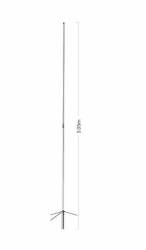
• Frequency: 144/430/1200 MHz
• Type: 2x5/8λ (144), 5x5/8λ (430), 6x5/8 (1200)
• Gain: 6.5dB (144), 9dB (430), 10dB (1200)
• Power: 100 Watts
• Impedance: 50 Ohms
• VSWR : 1.5:1
• Rated wind velocity: 50 m/sec
• Mast diameter accepted: 30-62 mm
• Length: 3.05 m
• Radial length: 52 cm
• Weight: 1.8 kg
• Connector: N-female
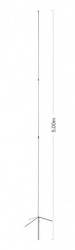
• Frequency: 144/430/1200 MHz
• Type: 3x5/8λ (144), 8x5/8λ (430), 14x5/8λ (1200)
• Gain: 8.3dB (144), 11.7dB (430), 13.7dB (1200)
• Power: 100 Watts
• Impedance: 50 Ohms
• VSWR : 1.5:1
• Rated wind velocity: 40 m/sec
• Mast diameter accepted: 30-62 mm
• Length: 5 m
• Radial length: 52 cm
• Weight: 2.2 kg
• Connector: N-female
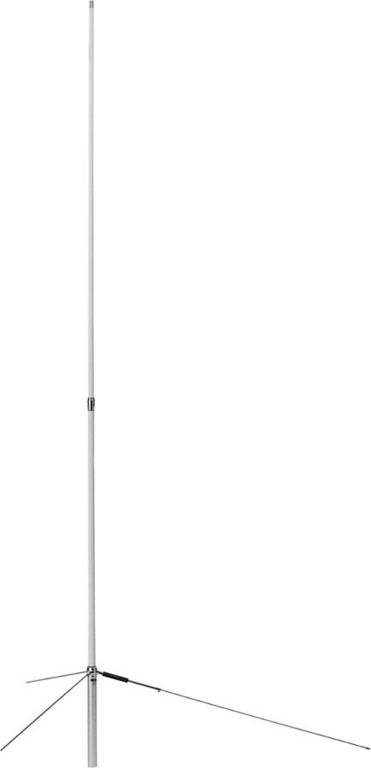
• Frequency: 50/144/430 MHz (6m/2m/70cm)
• Type: 50MHz - 1/2 λ; 144MHz - 2 x 5/8 λ; 430MHz - 4 x 5/8 λ
• Impedance: 50Ω
• Maximum power rating: 150W (Total)
• Maximum wind resistance: 50m/sec
• Gain: 50MHz - 2.15 dBi; 144MHz - 6.2 dB; 430MHz - 8.4 dB
• Length: 2.5 m; Radial: approx. 92cm
• Weight: 1.2 kg
• Mounting mast: Ø 30-62 mm
• Connector: UHF-female
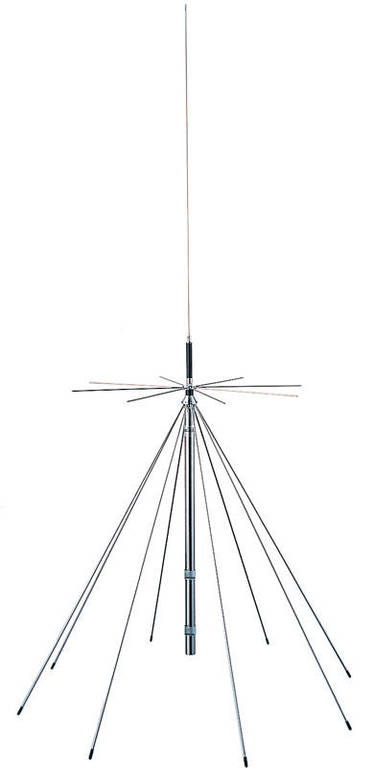
• Type: Super Discone
• Frequency range: RX 25-3000 MHz; TX(@ SWR ≤2): 50-1200 MHz
• Impedance: 50Ω
• Radiation (H-plane): 360° omnidirectional
• Radiation (E-plane): frequency dependent, see the pattern
• Radiation angle: frequency dependent, see the pattern
• Polarization: linear vertical
• Gain: 0 dBd - 2 dBi @ lowest frequency
• Max. Power (CW) @ 30°C: 200 Watts
• Connector: N-female, gold plated central pin
• Frequency: 144/430MHz (2m/70cm)
• Length: 5.2 m
• Weight: 2.08 kg
• Gain: 8.3dB (144MHz), 11.7dB (430MHz)
• Impedance: 50Ω
• Max.power rating: 350W
• VSWR: Less than 1.5:1
• Rated wind velocity: 40m/sec.
• Connector: amphenol male
• Type: 3x5/8wave C-Load(144MHz),8x5/8wave C-Load(430MHz),FRP outershell
• Mast diameter accepted:30mm to 60mm
Diamond multiband base station antenna - main technical characteristics
The Diamond antenna range includes base station antennas designed for different radio frequency applications. In addition to 144/430 MHz configurations, triple-band antennas supporting 1200 MHz operation are also available. The category includes a separate 50/144/430 MHz antenna, a 120/300 MHz receiving antenna, and a wideband Super Discone configuration. Electrical and mechanical parameters differ between antenna designs, so frequency, gain, maximum power, connector type, and physical dimensions should all be checked when selecting the appropriate configuration.
Which frequency bands are supported by Diamond multiband antennas?
The dual-band VHF/UHF antenna configurations are designed for 144 MHz and 430 MHz operation. Triple-band versions support 144/430/1200 MHz or 50/144/430 MHz combinations. The receiving antenna has documented reception frequencies of 120 MHz and 300 MHz. The Super Discone configuration provides a receiving frequency range of 25-3000 MHz and a transmitting frequency range of 50-1200 MHz. These different frequency configurations have distinct electrical characteristics.
VHF and UHF antenna configurations for amateur radio applications
The VHF antenna and UHF antenna functions are combined in 144/430 MHz base station antennas with different lengths and gain values. Documented gain ranges from 3.0 to 9.3 dB at 144 MHz and from 5.5 to 13 dB at 430 MHz. Maximum output power is 150 W or 200 W for most dual-band configurations, while another version has a maximum rated power of 350 W.
Diamond dual-band base station antenna for 144/430 MHz
The 144/430 MHz dual-band configurations have lengths ranging from 1.3 m to 7.2 m. Documented weights range from 0.8 kg to 3.8 kg. Gain varies according to antenna length and construction, so the VHF and UHF values must be considered separately. Most configurations use an N female connector, while one version with a maximum power rating of 350 W is equipped with an Amphenol male connector.
What antenna gain is available in the VHF and UHF bands?
- 144 MHz: 3.0 dB, 4.5 dB, 6.0 dB, 6.5 dB, 8.3 dB, or 9.3 dB gain.
- 430 MHz: 5.5 dB, 7.2 dB, 8.0 dB, 9.0 dB, 11.7 dB, or 13 dB gain.
- Maximum power: 150 W, 200 W, or 350 W, depending on the configuration.
- Documented antenna length: 1.3-7.2 m.
- Documented weight: 0.8-3.8 kg.
Each gain value applies to its corresponding frequency band. The 144 MHz and 430 MHz values should therefore be compared separately with the operating frequency of the radio equipment and the power specifications of the selected antenna.
Dual-band, triple-band, and wideband base station antennas
The multiband antenna range also includes triple-band configurations for 144/430/1200 MHz. These antennas use different wavelength-based antenna structures for each frequency band. Documented designs include 6/8 Lambda, 2 x 5/8 Lambda, 3 x 5/8 Lambda, 5 x 5/8 Lambda, 6 x 5/8 Lambda, 7 x 5/8 Lambda, 8 x 5/8 Lambda, and 14 x 5/8 Lambda configurations.
Diamond triple-band antenna for 144/430/1200 MHz applications
The triple-band configurations provide gain values of 4.5-8.3 dB at 144 MHz, 8.3-11.7 dB at 430 MHz, and 10-13.7 dB at 1200 MHz. Their maximum output power is 100 W at 144/430 MHz and 60 W at 1200 MHz. Documented lengths are 1.8 m, 3.05 m, and 5 m, while weights are 0.9 kg, 1.8 kg, and 2.2 kg. All three configurations use N female connectors.
How does the 50/144/430 MHz base station antenna differ?
The 50/144/430 MHz amateur radio antenna combines three different antenna structures. The 50 MHz section uses a 1/2 Lambda design, the 144 MHz section uses 2 x 5/8 Lambda, and the 430 MHz section uses 4 x 5/8 Lambda. Documented gain is 2.15 dBi at 50-52 MHz, 6.2 dB at 144 MHz, and 8.4 dB at 430 MHz. Maximum total output power is 150 W, antenna length is 2.5 m, and weight is 1.2 kg. The radial is approximately 92 cm long, and the connector is UHF female.
Wideband receiving antenna and Super Discone configuration
The category also includes antennas that differ from conventional dual-band and triple-band designs. The 120/300 MHz receiving antenna uses a 5/8 Lambda configuration at 120 MHz and a 2 x 5/8 Lambda configuration at 300 MHz. Its gain is 2.15 dBi at 120 MHz and 5.5 dBi at 300 MHz, with an impedance of 50 ohm. The antenna is 1.7 m long, weighs 1 kg, and can be mounted on a pipe or mast with a diameter of 30-62 mm. It uses a UHF female connector and has documented wind resistance of 60 m/s.
What frequency range does the Super Discone antenna cover?
The Super Discone antenna has a documented receiving frequency range of 25-3000 MHz and a transmitting frequency range of 50-1200 MHz. Its impedance is 50 ohm, with a 360-degree omnidirectional radiation pattern and gain of 0-2 dBi. Maximum power is 200 W at 144 MHz, and the connector is N female. The wideband receiving and transmitting frequency ranges are specified separately and must not be interchanged.
What antenna gain and maximum power ratings are available?
Antenna gain varies significantly depending on the frequency band and construction. The dual-band 144/430 MHz configurations provide 3.0-9.3 dB gain at 144 MHz and 5.5-13 dB gain at 430 MHz. Triple-band antennas supporting 1200 MHz provide 10-13.7 dB gain at that frequency. Maximum power is specific to each antenna configuration, making it particularly important to consider frequency-dependent power ratings for triple-band antennas.
Diamond base station antenna power specifications
- 144/430 MHz dual-band configurations: 150 W or 200 W maximum power.
- Higher-power 144/430 MHz configuration: 350 W maximum rated power.
- 144/430/1200 MHz triple-band antennas: 100 W at 144/430 MHz and 60 W at 1200 MHz.
- 50/144/430 MHz configuration: 150 W maximum total power.
- Super Discone configuration: 200 W maximum power at 144 MHz.
The documented power ratings are not identical for all antennas. We recommend comparing the transmitter output power with the maximum power rating specified for the relevant frequency band of the selected antenna.
Which connector and mounting options are available?
The Diamond multiband base station antenna category includes N female, UHF female, and Amphenol male connector configurations. Most 144/430 MHz and 144/430/1200 MHz antennas use N female connectors. The 50/144/430 MHz and 120/300 MHz configurations use UHF female connectors. One VHF/UHF configuration rated for 350 W maximum power uses an Amphenol male connector.
Diamond fixed-installation antenna mechanical specifications
When selecting a fixed-installation antenna, length, weight, and mast mounting requirements are also important. The documented dual-band antennas range from 1.3 m to 7.2 m in length, while triple-band versions range from 1.8 m to 5 m. One 5.2 m antenna rated for 350 W weighs 2.08 kg and features an FRP outer shell, an accepted mast diameter of 30-60 mm, and a rated wind speed of 40 m/s. This configuration has a VSWR below 1.5:1.
Antenna impedance, VSWR, and mechanical parameters
The documented antenna impedance is 50 ohm for the receiving antenna, Super Discone configuration, and higher-power VHF/UHF antenna. The latter has a VSWR below 1.5:1. Mechanical construction varies considerably between configurations, particularly in antenna length and weight. The available installation environment should therefore be considered when selecting the appropriate antenna.
What should be checked when selecting a Diamond multiband base station antenna?
The first step is to determine the required frequency bands. The 144/430 MHz dual-band antennas, 144/430/1200 MHz and 50/144/430 MHz triple-band configurations, and wideband receiving antennas have different technical specifications. In addition to frequency, gain, maximum power, connector type, antenna length, weight, and documented mast mounting requirements should also be checked.
Diamond antenna selection checklist
- 144/430 MHz dual-band or triple-band frequency configuration.
- 50/144/430 MHz or 144/430/1200 MHz operation.
- 120/300 MHz receiving antenna or wideband Super Discone design.
- Documented antenna gain for each frequency band.
- Maximum power between 60 W and 350 W, depending on the configuration and frequency.
- 50 ohm impedance where documented.
- VSWR verification where specifications are available.
- N female, UHF female, or Amphenol male connector.
- Antenna length, weight, and mast mounting specifications.
- Documented wind resistance for the relevant configuration.
Frequency bands, gain values, power ratings, and mechanical dimensions vary between antenna configurations. Selection should therefore always be based on the complete technical specifications of the intended antenna.
FAQ - Diamond multiband base station antennas
- Which frequency bands are available for Diamond multiband base station antennas?
The documented range includes 144/430 MHz dual-band antennas, 50/144/430 MHz and 144/430/1200 MHz triple-band antennas, and wideband receiving antennas. - What is the maximum antenna gain?
The highest documented gain in the category is 13.7 dB in the 1200 MHz band. - What maximum power ratings are available?
Documented values range from 60 W to 350 W, depending on the antenna and frequency band. - Are antennas supporting 50 MHz available?
Yes. The category includes a triple-band configuration for 50/144/430 MHz. - What frequency range does the Super Discone antenna support?
The receiving range is 25-3000 MHz, while the transmitting range is 50-1200 MHz. - Which antenna connectors are available?
Documented connections include N female, UHF female, and Amphenol male. - What antenna lengths are available?
The documented lengths of configurations with specified dimensions range from 1.3 m to 7.2 m.
Summary
The Diamond multiband base station antenna category includes fixed-installation antennas designed for different VHF, UHF, and amateur radio frequencies. The range includes 144/430 MHz dual-band antennas, 50/144/430 MHz and 144/430/1200 MHz triple-band configurations, as well as wideband receiving antennas and Super Discone designs. Selecting the appropriate antenna requires checking the frequency bands, gain, maximum power, impedance, connector type, antenna length, and mast mounting requirements.