

- Special Offers
- Transceiver Radio
- Transceiver Accessory
- Antennas
- Antenna Accessory
- Antenna Rod and Radiator
- Magnet Mount for Antenna
- Drillable Antenna Base
- Antenna Mounting Bracket
- Antenna Mast and Fitting
- Antenna Switch and Coax Switch
- SWR Meter, Antenna Tuner
- Antenna Surge Suppressor
- Grounding Accessories
- Grounding Clamp
- Grounding Bracket
- Antenna Rotator and Motor Driven Antenna Mount
- Antenna Dummy Load
- WiFi Antenna Splitter and Coupler
- Wingscrew
- Antenna Meter
- TV Antenna Splitter
- Multiswitches
- TV Antenna Combiner
- TV Antenna Amplifier
- LNB Head for Satellite Dish
- TV Headend
- Fiber Optics
- Cable
- Connector
- Installation Material
- Installation Tools
- Measuring Equipement
- Body Worn Camera
- Electrosmog
- Telephone
- Baby Monitor
- Fever Thermometer
- Radio Device
- Set-top Boxes
- Personal Protective Equipment
- Motorcycle Helmet Speaker
- Car Equipment
- Voltage Converter
- Dry Cell
- Battery
- Battery Charger
- Emergency Signal
- Amber Signal
- Sound Signal
- Light and Sound Signal Accessory
- Traffic Engineering
- LED Lamp
- Smart Home
- Mosquito Repellent Device
- Market - Other Products
- Discontinued Products
Pre-order (1)
Grounding Bracket
A grounding bracket can be used in F-connector coaxial systems to provide cable connections and to establish a grounding or equipotential bonding connection. Such designs can connect the outer conductors of multiple coaxial cables to a common equipotential bonding point. When selecting a grounding bracket, the main parameters to check are the number of F-connector positions, the method used to connect the grounding conductor, and the electrical characteristics of the specific product. Read more...
Pre-order (1)
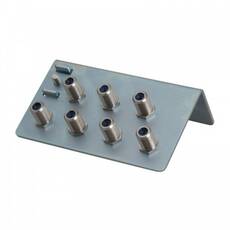
• 7-pole, with F-connectors on both ends
• Frequency range: 0 – 2400 MHz
• Shielding level: > 90 dB
• Material / surface: electrogalvanized steel
• Function: grounding and noise filtering of coaxial cables

Grounding bracket for F-connector coaxial systems
In coaxial distribution systems, equipotential bonding components can be used to connect the outer conductors of coaxial cables to a common equipotential bonding point. With grounding brackets equipped with double-sided F-connectors, the signal path can continue through the bracket while the conductive metal structure can be connected separately to a grounding or equipotential bonding conductor.
How does grounding connect to coaxial cables?
In equipotential bonding, the outer conductors of coaxial cables are connected to a common conductive point. The cross-section and connection method of the grounding conductor, as well as the overall system design, must always be determined according to the documentation of the equipment and the requirements applicable to the installation. The grounding bracket forms part of this connection point.
Which grounding bracket should you choose?
One of the main selection parameters is the number of coaxial cables that need to be connected. Grounding components with F-connectors can be available with different numbers of connection points. The required version therefore depends on how many coaxial branches need to be included in the same equipotential bonding point. It is also necessary to check that the cabling and the bracket use the same connector type.
Grounding conductor and equipotential bonding
The design of the grounding or equipotential bonding connection can vary by product type. Some grounding components use screw-type conductor fixing, while other versions use a threaded connection point. The permitted conductor cross-section is also product-specific and should therefore be checked before selecting the grounding conductor.
Important technical parameters of a grounding bracket
For coaxial grounding components with F-connectors, the technical data may include frequency range, impedance, insertion loss, return loss or shielding performance. These values can differ between products, so the number of connectors alone is not sufficient for product selection. The electrical characteristics of the selected grounding bracket should be checked together with the requirements of the coaxial system.
What is the role of the metal bracket design?
A grounding bracket is a conductive structural component, so the product data may also include information about the base material and surface finish. The specific material, surface treatment and mechanical construction can vary by manufacturer and product type. If these parameters are important for the planned installation, the technical specification of the individual product should always be checked.
Equipotential bonding in antenna and distribution systems
The equipotential bonding point of a coaxial distribution system can be implemented with a metal bar that directly contacts the cable shielding, or with a block containing double-sided F-connectors. With an F-connector grounding bracket, coaxial cables can be routed through the connectors while the bracket provides a common equipotential bonding connection.
How is a grounding bracket related to electrical safety?
The grounding and equipotential bonding of a coaxial network must be treated as part of the complete installation system. The grounding bracket itself does not define the required conductor cross-section, the complete grounding arrangement or the associated protective measures. These must be determined according to the technical requirements of the installation and the documentation of the equipment used.
What should you check when selecting a grounding bracket?
We recommend first checking the connector type and the number of coaxial cables. Then compare the required frequency range with the technical data of the bracket and check the connection point provided for the grounding conductor. If shielding, impedance or attenuation data are specified for the product, these should also be checked against the system parameters.
Advantages and limitations of grounding brackets
- Advantage: multiple F-connector coaxial cables can be connected to a common equipotential bonding point.
- Advantage: with versions using double-sided F-connectors, the coaxial cable connection can pass through the bracket.
- Advantage: a separate connection point can be provided for the grounding or equipotential bonding conductor.
- Limitation: the number of connection points is defined by the individual product.
- Limitation: the frequency range, attenuation values and grounding conductor connection options can vary by product type.
Frequently asked questions about grounding brackets
- What is a grounding bracket used for?
In F-connector coaxial systems, it can be used to provide cable connections and a common grounding or equipotential bonding connection point. - Do all grounding brackets have the same number of F-connectors?
No. The number of connection points depends on the design of the individual product. - What should be checked before selection?
Check the connector type and quantity, the frequency range, the method used to connect the grounding conductor, and the electrical parameters specified for the product. - What is the role of an equipotential bonding connection?
It allows the outer conductors of coaxial cables to be connected to a common conductive point. - Can the correct bracket be selected only by the number of F-connectors?
The number of connectors is an important parameter, but the electrical characteristics of the product and the grounding conductor connection options must also be checked.
Grounding bracket summary
A grounding bracket can be used in F-connector coaxial systems to provide cable connections and to establish an equipotential bonding point. When selecting the appropriate type, check not only the number of connection positions but also the frequency range, the method used to connect the grounding conductor, and the electrical parameters specified for the product.