

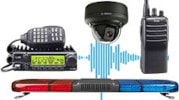
Icom Mobile Marine Radio
The Icom mobile marine radio category includes fixed-installation VHF as well as MF/HF marine radios. The VHF range includes versions with selectable 25 W and 1 W RF output power, Class D DSC, ATIS and MMSI handling, GPS or GNSS receivers, AIS reception, NMEA data connectivity and multi-station control. The MF/HF system provides Class E DSC, an integrated GNSS receiver, 12 V or 24 V power supply, NMEA 2000 and NMEA 0183/-HS connectivity, and 85 W or 125 W PEP output power. We recommend considering the frequency band, DSC class, AIS functionality, onboard data connections and installation configuration together when selecting a system. Read more...
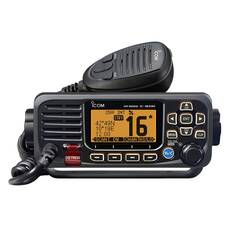
• VHF marine channels
• Maximum 25W RF output power
• ATIS code sending
• Large, full dot-matrix display
• AquaQuake draining function
• MA-500TR AIS transponder can be connected
• IPX7 waterproof protection (1 m depth of water for 30 minutes)
• Integrated GPS receiver (GPS antenna with 5 m cable)
• Available versions: black
• Easy Installation in Limited Space (W × H × D; 156.5 × 66.5 × 110.1 mm)


• IC-M510BB VHF marine radio with 2 handsets
• Frequency range: 156 - 163 Mhz
• Usable Channels: INT, USA, Atis channels
• Power supply requirement: 12 V DC
• IPX7 waterproof, 1 m depth water for 30 minutes
• Integrated GPS receiver
• Anchor Watch function
Transmitter:
• Output power: 25 W, 1 W
• Max frequency deviation: 5 kHz
• Frequency tolerance: 0.5 kHz


• VHF marine channels
• Maximum 25W RF output power
• ATIS and DSC channels with code sending
• Icom Marine Family User Interface, White Backlit LCD and Keypad
• AquaQuake draining function
• Built-in active noise cancelling and 10W external speaker amplifier
• Can be integrated into MarineCommander system
• MA-510TR AIS transponder can be connected
• IPX7 waterproof protection (n (1 m depth for 30 minutes))
• Integrated GPS receiver (GPS antenna supplied)

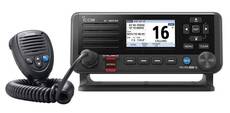
• Fixed-mount VHF/DSC marine radio
• 25 W RF output with Class D DSC
• Colour TFT LCD with 3 selectable display modes
• Built-in GPS (GNSS) receiver and antenna
• NMEA 2000 and NMEA 0183-HS connectivity
• Active Noise Cancelling on transmit and receive
• Dualwatch and Tri-watch monitoring functions
• Built-in hailer and automatic foghorn functions

• Space Saving Configuration for Limited Helm Space
• Install Up to Three Stations on Board with the IC-M510BB
• Built-in Class D DSC
• Integrated AIS Receiver
• NMEA 2000 and NMEA 0183-HS Connectivity
• Two Minutes Voice Recording Function
• Active Noise Cancelling Technology
• DSC Remote Control Interface for PC Console Software (EN 300 338-8 Compatible)
• Loud RX Hailer/Foghorn
• IPX7 waterproof (1 m depth water for 30 minutes)
• Integrated GPS receiver
• AquaQuake function
• External speaker connection from the CommandMic cable

• Output power (at 12 V DC): 25 W, 1 W
• Built-in active noise reduction and external speaker amplifier
• Class D DSC VHF marine radio with WLAN function
• Built-in GNSS receiver and GPS receiver
• AquaQuake function prevents degradation of sound quality when waterlogged speaker waterlogged
• Remote control via an app for iOS/Android systems
• Wide viewing angle colour TFT LCD
• NMEA 0183/HS and NMEA 2000 connection
• Control with COMMANDMIC HM-195 or HM-229 series
• IP68 dust and waterproof protection

• VHF marine channels
• Maximum 25W RF output power
• ATIS and DSC channels with code sending
• Integrated AIS receiver
• AquaQuake draining function
• Built-in active noise cancelling and external speaker amplifier
• Last call voice recording (max. 2 minutes)
• IPX8 advanced waterproof protection (1 m depth of water for 60 minutes)
• Compatible with the Icom’s marine navigation system, MarineCommander
• MA-500TR AIS transponder can be connected
• This product refers to the rear microphone version
• Dual and Tri-watch functions
• Instant-access button for Channel 16 and call channel
• Supports new four-digit channels effective from January 1, 2017

• Voltage: 12V
• Output power: 1.6-3.9999 MHz 85 W pep; 4.0-27.5000 MHz 125 W pep
• Built-in DSC watch-keeping receiver
• Distress button: simple digital alarm transmission
• Integrated GNSS receiver
• Two-minute instant replay memory
• Optional AT-141 automatic antenna tuner
• 4.3-inch wide-angle colour TFT display
• NMEA 2000, NMEA 0183/-HS connection
• IPX7 waterproof protection
• Voltage: 24V
• Output power: 1.6-3.9999 MHz 85 W pep; 4.0-27.5000 MHz 125 W pep
• Built-in DSC watch-keeping receiver
• Distress button: simple digital alarm transmission
• Integrated GNSS receiver
• Two-minute instant replay memory
• Optional AT-141 automatic antenna tuner
• 4.3-inch wide-angle colour TFT display
• NMEA 2000, NMEA 0183/-HS connection
• IPX7 waterproof protection
Icom mobile marine radio for VHF and MF/HF marine communication
The VHF marine radios include devices with selectable 25 W and 1 W output power. Documented functions include direct access to Channel 16, Dualwatch and Tri-watch monitoring, programmable channel management, priority channel monitoring and continuous monitoring of DSC Channel 70. Certain European versions also support ATIS channels and ATIS code transmission.
The MF/HF radio has a receive range of 500 kHz-29.9999 MHz, while transmission is provided in designated bands between 1.6-27.5000 MHz. Documented RF output power is 85 W PEP between 1.6-3.9999 MHz and 125 W PEP between 4.0-27.5000 MHz. The system is available in 12 V and 24 V versions and can be supplemented with an optional automatic antenna tuner.
VHF marine radio with 25 W RF output power and Class D DSC
The Class D DSC system uses Channel 70 for Digital Selective Calling. Documented DSC functions include distress calls, individual calls, group calls, all-ships calls, position sending, position requests and DSC test calls. Some VHF devices have a dedicated DISTRESS control for initiating a digital distress alert.
What DSC functions, AIS receiver and MMSI identification options are available?
The DSC function uses an MMSI identifier, while certain European VHF versions can also be programmed with an ATIS code. Systems with an integrated AIS receiver can receive AIS target information, and on certain devices an individual DSC call can be initiated directly to the selected AIS target. Other versions can be connected to an external Class B AIS transponder.
AIS receiver and MMSI identification in Icom VHF marine radios
AIS and DSC functions can be used together directly in certain systems. After selecting an AIS target handled by the radio, a DSC call can be initiated without manually entering the MMSI number when supported by the specific device and connected AIS system. The category includes both VHF radios with integrated AIS receivers and radios that can be connected to an external AIS transponder.
What does Class E DSC handle in an MF/HF mobile marine radio?
The MF/HF system complies with ITU-R M.493-15 and ETSI EN 300 338-4 Class E DSC requirements. The dedicated DSC receiver scans six distress frequencies. The memory stores 100 MMSI entries, including 75 individual and 25 group entries, with identification names of up to 10 characters.
GPS/GNSS, NMEA 0183 and NMEA 2000 onboard data connections
The category includes radios with integrated GPS or GNSS receivers and antennas. Certain systems can also use an external GNSS antenna or an NMEA 0183-compatible position source. Documented GNSS systems include GPS, GLONASS and SBAS. Position and time data can also be used for DSC functions.
What data can NMEA 0183 and NMEA 0183-HS connections transmit?
The NMEA 0183 interface can be used to connect external navigation or GNSS equipment. Certain VHF radios can forward received DSC position data to navigation equipment through an NMEA 0183 connection. Documented NMEA formats include RMC, GGA, GNS, GLL, VTG, DSC, DSE, GSA and GSV data.
NMEA 2000 system connectivity for Icom mobile marine radios
NMEA 2000-compatible systems can connect to other onboard electronic equipment, such as multifunction displays. Documented data exchange can include GNSS position, DSC call information, radio channel data and PGN data. The MF/HF system can also convert NMEA 0183/-HS GNSS position data into NMEA 2000 data for other network devices.
How can the ATIS code and DISTRESS emergency call be used?
The ATIS function is available on certain European VHF versions, while DSC operation is linked to MMSI identification. Pressing the DISTRESS button allows the DSC system to initiate a digital distress alert. With VHF Class D DSC, Channel 70 is used for the digital alert, after which voice communication can continue on Channel 16.
DISTRESS emergency call with GNSS coordinates in the MF/HF system
The MF/HF Class E DSC device can include GNSS coordinates in a digital distress alert transmitted to other vessels or coast stations. The integrated GNSS system handles GPS, GLONASS and SBAS data and can provide position, course, speed and UTC information. The system supports continuous scanning of six DSC distress frequencies.
Active noise cancelling, AquaQuake and water resistance in Icom mobile marine radios
The category includes devices with IPX7, IPX8 and IP68 protection ratings. The documented IPX7 protection is 30 minutes at a water depth of 1 m, while the IPX8 version is specified for 60 minutes at a depth of 1 m. The IP68 rating indicates a dustproof and waterproof design for the relevant device. The AquaQuake function uses a vibrating sound to help remove water remaining around the speaker.
Active Noise Cancelling and external speakers for Icom VHF marine radios
Certain VHF systems use Active Noise Cancelling during transmission and reception. Documented noise reduction can reach up to 90% on specific versions. External speaker outputs of 10 W or more than 15 W are available, along with hailer, RX hailer and automatic or manual foghorn functions. Certain devices automatically record the last two minutes of received audio for playback.
What multi-station, WLAN and remote-control options are available?
In addition to conventional front-panel radios, black box configurations are also available. In these systems, the main RF unit can be installed away from the operating position, while complete radio and DSC control can be performed from a CommandMic unit. Depending on the documented configuration, two or three control stations can be installed with intercom functionality.
Black box VHF marine radio with CommandMic and intercom functions
In certain black box systems, the RF unit can be installed up to 18.3 m away from the CommandMic unit when suitable extension cables are used. In multi-station configurations, VHF and intercom functions are accessible from several onboard control points. Certain versions support both all-call and one-to-one intercom communication.
How does WLAN control work with iOS and Android systems?
A VHF radio with WLAN functionality can be remotely controlled through a smart-device application. Up to three iOS or Android devices can be used as wireless microphones or remote controllers, and intercom communication is also available between the smart device and the radio. The documented WLAN standard is IEEE 802.11 b/g/n with 2.4 GHz operation.
Overview of documented Icom mobile marine radio functions
- VHF communication: 25 W and 1 W RF output power, Class D DSC, Channel 16, Dualwatch and Tri-watch.
- Digital functions: MMSI, ATIS, DISTRESS, individual, group and position-based DSC calls.
- AIS: integrated AIS receiver or connection to an external Class B AIS transponder on certain versions.
- Navigation: GPS/GNSS, NMEA 0183, NMEA 0183-HS and NMEA 2000.
- Audio: Active Noise Cancelling, external speaker, hailer, RX hailer, foghorn and two-minute audio recording on certain devices.
- Installation: conventional front-panel, flush-mount and black box configurations.
- MF/HF: Class E DSC, 85 W or 125 W PEP, integrated GNSS, 12 V or 24 V power supply and optional automatic antenna tuner.
Differences to consider: AIS receiver, ATIS, NMEA 2000, WLAN, AquaQuake, Active Noise Cancelling and multi-station control are not available on every device. VHF and MF/HF systems also differ in frequency range, DSC class, power supply and RF output power.
What are the most frequently asked questions about Icom mobile marine radios?
- Do all Icom mobile marine radios have an AIS receiver?
No. Certain VHF radios include an integrated AIS receiver, while other systems can be connected to an external AIS transponder. - What is the difference between Class D and Class E DSC in this category?
The documented VHF radios use Class D DSC systems, while the MF/HF system uses Class E DSC. - Can an NMEA 2000 connection be used?
Yes. Certain VHF and MF/HF versions include NMEA 2000 connectivity and can handle GNSS, DSC, radio or PGN data. - Is an integrated GPS or GNSS receiver available?
Yes. Several devices include an integrated GPS or GNSS receiver, and certain systems also support an external GNSS antenna. - Is ATIS code transmission available?
Yes. Certain European VHF marine radios support ATIS code operation. - Is a multi-station control solution available?
Yes. Certain black box and multi-station systems support two or three operating positions, CommandMic control and intercom functionality. - What output power is available?
The documented VHF devices provide selectable 25 W and 1 W RF output power. The MF/HF system provides 85 W PEP between 1.6-3.9999 MHz and 125 W PEP between 4.0-27.5000 MHz.
Summary: Icom mobile marine radio for onboard systems
The Icom mobile marine radio category includes several onboard communication configurations. The VHF systems can provide Class D DSC, AIS, ATIS, MMSI, GPS/GNSS, NMEA 0183, NMEA 2000, WLAN, AquaQuake, noise cancelling and multi-station control. The MF/HF version provides a Class E DSC system, monitoring of six DSC distress frequencies, 100 MMSI memory entries, an integrated GNSS receiver, NMEA data connections and 85 W or 125 W PEP output power. We recommend selecting the appropriate system according to the required frequency band, DSC functionality, AIS connection, installation method and onboard interfaces.