

Motorola Intrinsically Safe ATEX Two-Way Radio Transceiver
Motorola ATEX explosion-proof two-way radios are ATEX-certified MOTOTRBO handheld radios available in VHF and UHF versions. The category includes 136-174 MHz VHF, 403-470 MHz UHF and 400-470 MHz UHF versions. The radios support analogue and digital communication, emergency functions and, depending on the version, positioning, Wi-Fi and Bluetooth connectivity. Read more...
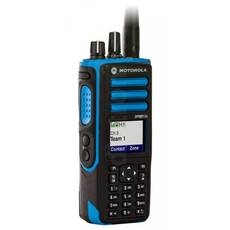
• Frequency coverage: 136-174MHz
• 1000 programmable channels
• 5-line full colour LCD display, full alphanumeric keypad
• 5 programmable option buttons, easy operation
• Digital MotoTRBO TDMA operation
• Especially designed to use in industrial environment
• Integrated GPS and Man Down function
• Maximum 1W RF output power
• Confirms with IP67 standard (dust-tight and waterproof protection)
• Equivalent to MIL-STD 810 D, E, F and G requirements
• Certified to ATEX Protection


• Frequency coverage: 403-470MHz
• 1000 programmable channels
• 5-line full colour LCD display, full alphanumeric keypad
• 5 programmable option buttons, easy operation
• Digital MotoTRBO TDMA operation
• Especially designed to use in industrial environment
• Integrated GPS and Man Down function
• Maximum 1W RF output power
• Confirms with IP67 standard (dust-tight and waterproof protection)
• Equivalent to MIL-STD 810 D, E, F and G requirements
• Certified to ATEX Protection
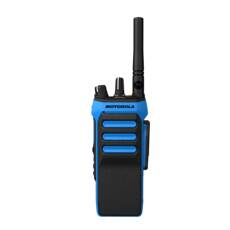
• Frequency band: 400-470 MHz
• Support for digital and analog signaling
• Management of 64 channels and 4 zones
• ATEX and IECEx certification for explosive environments
• GNSS positioning function
• 12.5 / 20 / 25 kHz channel spacing
• No-display, no-keypad (NKP) design
• Standard accessories: battery, antenna, belt clip, dust cover
• Motorola part number: PZA502BEx
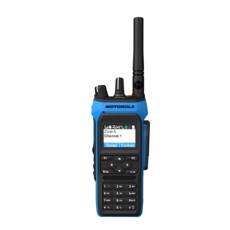
• Frequency band: 400-470 MHz
• Transmit power: 2 W / 1 W
• 1.7-inch color display with a resolution of 132 x 90 pixels
• Supports 1,000 channels and 250 zones
• Supports 2.4 GHz and 5 GHz Wi-Fi and Bluetooth 5.2
• Built-in GNSS positioning with GPS, GLONASS, BeiDou, and Galileo systems
• IP66 and IP68 protection, ATEX and IECEx certification
• Included: 2150 mAh Li-Ion IP68 battery
• Motorola part number: PZA502HEEx
Motorola ATEX explosion-proof two-way radio for hazardous working environments
Motorola ATEX radios are manufactured with defined protection classifications for potentially explosive gas, dust and mining environments. The DP4000 Ex series has a gas protection marking of II 2G Ex ib IIC T4, a dust protection marking of II 2D Ex ib IIIC T130C and a mining protection marking of I M2 Ex ib I. The R7Ex IIC version is marked II 2G Ex ib IIC T4 Gb for gas, II 2D Ex ib IIIC T130C Db for dust and I M2 Ex ib I Mb for mining applications. The ib protection method indicates an intrinsically safe design.
What do ATEX and IECEx certifications mean for Motorola MOTOTRBO radios?
The R7Ex has ATEX and IECEx certification. The II 2G classification applies to Zone 1 and Zone 2 gas, vapour and mist environments, while the II 2D classification applies to Zone 21 and Zone 22 dust environments. The IIC gas group also covers environments involving hydrogen and acetylene, while the T4 temperature class defines a maximum surface temperature of 135 C. The IIIC dust group also includes conductive dust. The mining I M2 classification relates to mining areas where methane and coal dust hazards may be present.
VHF, UHF, analogue and DMR digital radio communication
The DP4801 Ex VHF version can be programmed between 136-174 MHz, while the UHF version operates between 403-470 MHz, with a maximum RF output power of 1 W. Both versions support up to 1000 channels, 12.5/20/25 kHz channel spacing and MOTOTRBO TDMA digital operation. The R7Ex UHF version operates between 400-470 MHz; the full-keypad IIC version provides 2 W / 1 W RF output power, 1000 channels and 250 zones, while the no-keypad version provides 64 channels and 4 zones. The R7Ex supports analogue and digital signalling as well as DMR Tier II and DMR Tier III protocols.
What control and audio functions does the explosion-proof two-way radio provide?
The display-equipped DP4801 Ex features a full alphanumeric keypad, 5 programmable buttons, a 5-line colour display, a PTT button and an emergency button. Individual, group and all calls, PTT ID, channel scanning, remote monitoring, VOX, password protection and text messaging can be programmed. The R7Ex uses automatic acoustic feedback suppression, AI-trained Noise Suppression, SINC+, Intelligent Audio and IMPRES functions, with loudness programmable up to 108 phon.
ATEX gas, dust and mining protection classifications
The R7Ex has IP66 and IP68 protection; the IP68 test specifies immersion in water at a depth of 2 metres for 2 hours. The housing has resistance to disinfectants and decontamination agents, and the device is tested according to MIL-STD 810 requirements. The DP4801 Ex has IP67 protection, including immersion at a depth of 1 metre for 30 minutes, and complies with MIL-STD 810 D, E, F and G requirements. The blue housing helps identify the explosion-proof version.
How do Lone Worker, Man Down and Fall Alert functions support operation?
The DP4801 Ex includes built-in Man Down and Lone Worker functions. Man Down can initiate an emergency call under programmed conditions based on tilt angle, acceleration and prolonged lack of movement. Lone Worker can issue a warning after an inactivity period of 1-255 minutes and, if there is no response within a programmed period of 1-255 seconds, can automatically initiate an emergency call. The R7Ex includes a dedicated emergency button, Lone Worker and Fall Alert functions, and also provides a warning if a non-ATEX battery is installed.
Motorola ATEX radio IP protection and battery operating time
With a 2075 mAh Li-Ion battery, the DP4801 Ex provides up to 16 hours of analogue and 19 hours of digital operating time under a typical 5/5/90 duty cycle. The R7Ex IIC version with a 2150 mAh Li-Ion IP68 battery provides up to 23.5 hours of digital and 20.5 hours of analogue operating time. The display-equipped version measures 140 x 57 x 40 mm and weighs 438 g with battery or 460 g with whip antenna. The no-keypad version measures 140 x 57 x 38 mm and weighs 419 g with battery and without antenna or 441 g with antenna. The R7Ex operating temperature range is -30 to +60 C.
What GNSS, Bluetooth and Wi-Fi functions are available on the R7Ex radio?
The display-equipped R7Ex GNSS positioning system supports GPS, GLONASS, BeiDou and Galileo. The full-keypad version supports 2.4 and 5 GHz Wi-Fi, IEEE 802.11a/b/g/n/ac standards, WPA3 and WPA2 security protocols, and IEEE 802.11k/v/r roaming. Bluetooth Core 5.2 Class 2 has a nominal range of 10 m, and one audio connection plus up to four data connections can be used simultaneously.
Motorola MOTOTRBO system integration and DMR functions
The R7Ex supports Dual Capacity Direct Mode, Conventional, IP Site Connect, Capacity Plus single-site and multi-site systems; Capacity Max is available as a version-dependent option. Over-the-Air Programming can be used over DMR, while the display-equipped Wi-Fi version also supports Wi-Fi-based software updates. The DP4000 Ex family can also be used in IP Site Connect, Capacity Plus and Linked Capacity Plus systems, with GPS location tracking and application-dependent text messaging, call logging and recording functions.
What should be considered for radio licensing, programming and ATEX accessories?
A professional two-way radio system operating on dedicated or repeater frequencies requires frequency assignment authorisation and a radio licence, while the devices may also require programming. In ATEX environments, accessory compliance is also important: R7Ex accessories are tested together with the radio to maintain ATEX/IECEx certification for the complete system. Repairs involving opening the radio require specialised service technology.
Motorola ATEX radio advantages and limitations
- Advantage: documented ATEX gas, dust and mining classifications, with IECEx certification on the R7Ex.
- Advantage: analogue and digital DMR communication with emergency and positioning functions.
- Advantage: IP67 or, depending on the version, IP66/IP68 protection and MIL-STD 810 compliance.
- Limitation: frequency range, RF output power, channel capacity, wireless connectivity and battery operating time vary by model.
- Limitation: accessories approved for use with the radio are required to maintain ATEX compliance.
Selection should therefore begin with the required ATEX gas, dust or mining classification, followed by the required VHF/UHF frequency band and the preferred user interface.
Frequently asked questions about Motorola ATEX explosion-proof two-way radios
- Which frequency bands are available?
The category includes 136-174 MHz VHF, 403-470 MHz UHF and 400-470 MHz UHF versions. - Can they be used in both analogue and digital systems?
Yes. The documented devices support analogue and digital operation, while the MOTOTRBO digital system is based on DMR technology. - What level of water and dust protection do they provide?
The DP4801 Ex has IP67 protection, while the R7Ex has IP66 and IP68 protection. - Is positioning available?
Yes. The earlier version uses integrated GPS, while the R7Ex uses GNSS; the display-equipped R7Ex supports GPS, GLONASS, BeiDou and Galileo. - Is a radio licence required?
A professional two-way radio system using dedicated or repeater frequencies requires frequency assignment and a radio licence.
The specific radio version should be selected according to the hazardous-area classification, required frequency band, channel and zone capacity, positioning requirements, wireless functions and user interface.
Summary for selecting a Motorola ATEX explosion-proof two-way radio
We recommend starting with the required ATEX certification level, then selecting the appropriate VHF or UHF frequency band, display or no-display operation, and the required DMR system functions. If GNSS positioning, Wi-Fi, Bluetooth, longer battery operating time or IP66/IP68 protection is required, the technical specifications of the R7Ex versions should be compared with those of the earlier IP67 Motorola ATEX radios.