

Sirio Base Station Multiband Antenna
The Sirio multiband base antenna category includes fixed-installation, vertically polarized radio antennas for VHF and UHF reception and for transmission within designated amateur radio bands. The range includes dual-band collinear and wideband discone designs. Depending on the version, the discone antennas cover receive ranges of 25-1300 MHz, 100-2000 MHz or 300-3000 MHz, while transmission is limited to separately specified TX frequency sections. Selection must therefore take the frequency range, 50 ohm impedance, N connector, permitted transmitter power and mast dimensions into account. Read more...
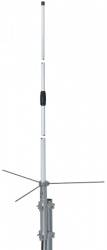
• Type: VHF: 6/8 λ; UHF: 3 x 5/8 λ colinear
• Frequency range: VHF: 142-148 MHz; UHF: 427-442 MHz
• Impedance: 50Ω
• Radiation (H-plane): 360° omnidirectional
• Radiation (E-plane): VHF: beamwidth @ -3 dB = 61°; UHF: beamwidth @ -3 dB = 30°
• Radiation angle: VHF 0°; UHF 0°
• Polarization: linear vertical
• Gain: VHF: 2 dBd - 4.15 dBi; UHF: 4.2 dBd - 6.35 dBi
• Max. Power (CW) @ 30°C: 200 Watts
• Grounding protection: All metal parts are DC-grounded, the inner conductor is coupled capacitively
• Connector: N-female, gold plated central pin

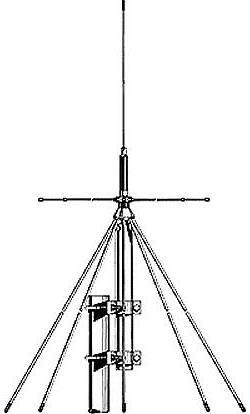
• Type: discone
• Frequency range: RX band: 25-1300 MHz; TX band (@ SWR ≤2): 49.5-50.5, 120-180, 215-300, 415-465, 610-650, 710-1000, 1130-1300 MHz
• Impedance: 50Ω
• Radiation (H-plane): 360° omnidirectional
• Radiation (E-plane): frequency dependent, see the pattern
• Radiation angle: frequency dependent, see the pattern
• Polarization: linear vertical
• Gain: 0 dBd - 2.15 dBi @ lowest frequency
• Max. Power (CW) @ 30°C: VHF: 300 Watts; UHF: 200 Watts
• Connector: N-female, gold plated central pin
• Type: discone
• Frequency range: RX band: 100-2000 MHz; TX band (@ SWR ≤2): 130-160, 215-440, 610-685, 870-960, 1070-1500, 1620-1800, 1860-2000 MHz
• Impedance: 50Ω
• Radiation (H-plane): 360° omnidirectional
• Radiation (E-plane): frequency dependent, see the pattern
• Radiation angle: frequency dependent, see the pattern
• Polarization: linear vertical
• Gain: 0 dBd - 2.15 dBi @ lowest frequency
• Max. Power (CW) @ 30°C: 200 Watts
• Connector: N-female, gold plated central pin
• Type: discone
• Frequency range: RX band: 300-3000 MHz; TX band (@ SWR ≤2): 340-535, 545-960, 1180-1380, 1660-1910, 1980-3000 MHz
• Impedance: 50Ω
• Radiation (H-plane): 360° omnidirectional
• Radiation (E-plane): frequency dependent, see the pattern
• Radiation angle: frequency dependent, see the pattern
• Polarization: linear vertical
• Gain: 0 dBd - 2.15 dBi @ lowest frequency
• Max. Power (CW) @ 30°C: 200 Watts
• Connector: N-female, gold plated central pin

Sirio multiband base antenna for VHF and UHF radio systems
The antennas in this category are designed for base station installation and provide a 360-degree omnidirectional radiation pattern in the H-plane. Polarization is vertical and nominal impedance is 50 ohms. The dual-band collinear version is associated with the 2 m and 70 cm amateur radio bands, while the discone antennas provide wideband reception and several separately specified transmit frequency sections. The discone models use direct center feed.
What applications can a multiband antenna support?
For receive applications, the RX frequency range is the primary selection parameter. The category includes discone versions covering 25-1300 MHz, 100-2000 MHz and 300-3000 MHz. The dual-band collinear antenna operates from 142-148 MHz and 427-442 MHz with an SWR of no more than 2. For transmission, the TX frequency sections specified for the selected version must always be followed.
Discone antenna and collinear Sirio antenna design
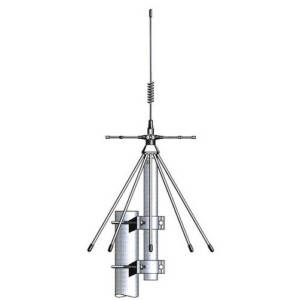
The discone antenna consists of horizontal and conical radials, a vertical radiator, a central feed point and mast mounting hardware. The discone versions are made from aluminium, chrome-plated brass, stainless steel and nylon. The VHF section of the dual-band Sirio antenna uses a 6/8 wavelength design, while the UHF section uses a 3 x 5/8 wavelength collinear configuration. The brass radiator is enclosed in a fibreglass tube, while the radials and mounting hardware are made from stainless steel.
How are the receive and transmit frequency ranges separated?
The RX range defines the receive frequency coverage of the antenna. The SD 1300 TX sections, with a maximum VSWR of 2:1, are 49.5-50.5, 120-180, 215-300, 415-465, 610-650, 700-1000 and 1130-1300 MHz. The SD 2000 transmit sections, with a maximum VSWR of 2.1:1, are 130-160, 221-445, 610-682, 860-960, 1075-1500 and 1610-2000 MHz. The SD 3000 TX sections, with a maximum VSWR of 2:1, are 340-535, 545-960, 1180-1380, 1660-1910 and 1980-3000 MHz. On certain versions, the vertical radiator can be removed when operation at 50 MHz or 145 MHz is not required.
VHF antenna and UHF antenna for 50 ohm systems
The discone versions have 50 ohm unbalanced impedance, while the dual-band antenna also has an impedance of 50 ohms. H-plane radiation is 360-degree omnidirectional and polarization is linear vertical. The dual-band collinear version has a -3 dB E-plane beamwidth of 61 degrees on VHF and 30 degrees on UHF, with a radiation angle of 0 degrees on both bands. The E-plane radiation pattern and radiation angle of the SD 2000 are frequency-dependent.
What do the gain and power ratings mean?
The dual-band collinear version has a gain of 2 dBd, or 4.15 dBi, on VHF and 4.2 dBd, or 6.35 dBi, on UHF. The documented gain of the discone versions is 0 dBd and either 2.15 or 2.2 dBi; for the SD 1300 and SD 2000, this value applies at the lowest frequency. Permitted transmitter power is 200 W, while one discone version supports 300 W on VHF and 200 W on UHF. The maximum transmitter power of the SD 2000 is 200 W CW.
N connector and coaxial connection on the base antenna
The webshop category contains versions fitted with an N socket. The dual-band antenna uses an N-female connector with a gold-plated center contact. The discone family is available in N and U versions: the N version uses an N-female connector, while the U version uses a UHF-female coaxial connector. Both connector versions of the SD 2000 have a gold-plated center contact. All metal parts of the dual-band antenna are DC grounded, while the inner conductor is capacitively coupled. The coaxial cable and radio system must follow a 50 ohm impedance configuration.
What should be considered when installing a fixed base antenna?
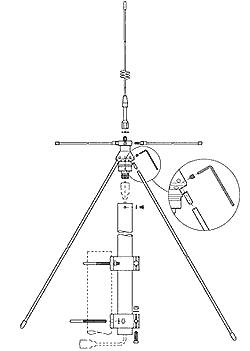
The discone base antenna versions can be mounted on masts with a diameter of 25-54 mm. The dual-band collinear antenna requires a mast with a diameter of 35-54 mm, and the mast is not included. Installation of this version requires a 10 mm open-ended spanner. The mounting components include an aluminium tube, three 170 mm stainless steel radials, M6 fasteners and an aluminium mounting bracket. The installation drawings also specify the assembly order of the radials, vertical radiator and mast clamps.
Materials and mechanical data for outdoor radio antennas
The outdoor radio antenna versions have heights of 725 mm, 940 mm, 1600 mm or 1720 mm and weights of 830 g, 1020 g, 1030 g or 1140 g. Wind surface areas are 0.03 m2, 0.04 m2, 0.05 m2 or 0.06 m2, while the specified wind loads at 150 km/h are 32 N, 44 N, 55 N or 66 N. Wind resistance is 130, 150 or 180 km/h, depending on the version. Radial length and radial arrangement correspond to the antenna design, and the installation drawings specify the positions of the horizontal and conical elements separately.
How should you select an amateur radio antenna?
First, the receive and transmit frequencies of the radio must be matched to the RX and TX data of the antenna. The N socket and coaxial cable connection, 50 ohm impedance and radio output power must then be checked. For outdoor installation, mast diameter, available mounting space, antenna height, weight, wind surface area and wind load data must also be included in the technical selection process. We recommend checking these parameters individually before ordering.
Sirio base antenna benefits and limitations
The main technical characteristics of the category are:
- versions with receive ranges of 25-1300 MHz, 100-2000 MHz or 300-3000 MHz;
- multiple specified amateur radio TX frequency sections;
- 360-degree omnidirectional H-plane radiation pattern;
- 50 ohm impedance and N-female connection option;
- mast-mounted base station construction.
The technical limitations must also be considered:
- the transmit range is not identical to the complete receive range;
- permitted transmitter power and VSWR limits are specified separately for each version;
- the N and U versions use different coaxial connectors;
- mast diameter and wind load must be checked for the installation location.
The technical data of the selected antenna must match the radio, coaxial cabling and installation point.
What are the most common questions about Sirio multiband base antennas?
- Can a Sirio multiband base antenna be used for both reception and transmission?
Yes, but transmission is permitted only within the TX frequency sections specified for the selected antenna. - What impedance should the coaxial system have?
The antennas in this category have an impedance of 50 ohms. - What polarization does the radio antenna use?
Polarization is vertical and the H-plane radiation pattern is 360-degree omnidirectional. - Which connector is fitted to the versions listed in the webshop?
The category contains models with an N socket, while certain members of the product family are also available with a UHF-female connector. - What mast diameter can be used for installation?
The discone versions can be mounted on masts with a diameter of 25-54 mm, while the dual-band collinear version requires a diameter of 35-54 mm.
The exact TX range, transmitter power, connector and mechanical dimensions must always correspond to the technical data of the selected version.
Summary
The Sirio multiband base antenna category includes dual-band collinear and wideband discone antennas. Their common technical characteristics include 50 ohm impedance, vertical polarization, 360-degree H-plane radiation and mast mounting. The appropriate version is determined by the combined verification of the RX and TX frequency ranges, permitted transmitter power, N coaxial connection and mechanical and wind load data.