

Electrosmog Measurement
The purpose of electrosmog measurement is the objective, instrumental determination of artificially generated electromagnetic fields and radiofrequency radiation. Modern telecommunications systems, wireless networks, industrial equipment, and electrical power infrastructure create an increasingly complex electromagnetic environment, the assessment of which is a fundamental requirement in numerous technical fields. Electrosmog measurement enables the identification of various radiation sources, the documentation of radiation levels, and evaluation in accordance with relevant standards. Professional measurements are particularly important in telecommunications, industrial, metrology, and EMC environments. Read more...
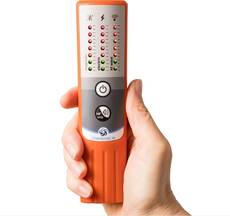
• Low-frequency electrical fields (LF) from 10 Hz to 5 kHz
• Low-frequency magnetic fields (LF) from 10 Hz to 5 kHz
• Electromagnetic fields (HF) from 1 MHz to 8 GHz
• 3D-measuring of magnetic fields (otherwise only available in very expensive devices)
• Operating modes: Standard mode, high resolution mode HF
• Audio indicator: Sound analysis for easy detection of radiation sources
• Power supply: 9 V battery
• Weight: 90 g
• Size: 178 x 50 x 33 mm
• Scope of delivery: Detector, battery, short operating manuals in German and English


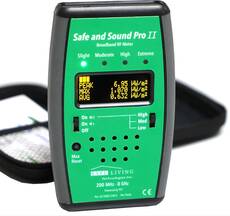
• A true ± 6 dB response from 400 MHz - 7.2 GHz and a full frequency response from 200 MHz - 8 GHz
• Ability to detect short pulses (< 5 µs) including 5G
• High sensitivity and resolution at low levels
• Long battery life: >15 hours with speaker on
• A clear display with PEAK, MAX & AVG readings
• Measures up to 2,500,000 µW/m²
• Loud adjustable speaker sound output - 3 levels
• 1/8” stereo headphone jack
• Continuous operation via USB power

• Detects and measures 5G in the high mmWave band, 20 GHz to 40 GHz
• North America’s first-ever, consumer-level, high-band millimeter wave meter
• Professionally accurate and affordable – at a fraction of the cost of current high-band detectors
• The perfect companion to Safe and Sound Pro II RF Meter, it’s the missing link to revealing the full range of 5G frequencies
• Digital display in micro watts/m² and V/m, includes audio, peak and average readings with maximum peak hold
• Quickly determine RF present in your environment within 20 GHz and 40 GHz
• Some of the more common sources the meter can detect: 5G cell towers, 5G cell phone emissions, higher frequency radar and other 5G high band devices

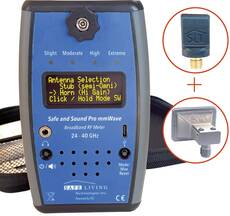
• Detects and measures 5G in the high mmWave band, 20 GHz to 40 GHz
• North America’s first-ever, consumer-level, high-band millimeter wave meter
• Professionally accurate and affordable – at a fraction of the cost of current high-band detectors
• The perfect companion to Safe and Sound Pro II RF Meter, it’s the missing link to revealing the full range of 5G frequencies
• Digital display in micro watts/m² and V/m, includes audio, peak and average readings with maximum peak hold
• Quickly determine RF present in your environment within 20 GHz and 40 GHz
• Some of the more common sources the meter can detect: 5G cell towers, 5G cell phone emissions, higher frequency radar and other 5G high band devices
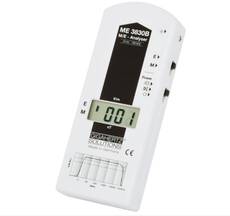
• Measuring range: 1 nT/Vm up to 2,000 nT/Vm
• Frequency range: 16 Hz up to 100 kHz
• Accuracy: 2 %, 14 digits
• An acoustic signal proportional to the field strength with “Geiger-counter-effect” helps identifying regions with increased exposure
• Included in delivery: Measurement device, Alkaline Mangan battery, detailed instruction manual with factual background information issuing "electro smog"
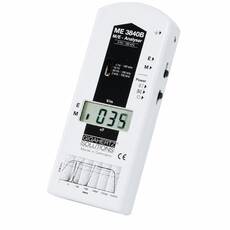
• Frequency range: 5 Hz-100 kHz
• Magnetic flux density measurement range: 1-1999 nT
• Electric field strength measurement range: 1-1999 V/m
• Internal switchable frequency filter: 16 Hz, 50 Hz and 2 kHz
• For measuring electric and magnetic LF alternating fields
• Switchable sound signal proportional to field strength
• 9 V battery, automatic power-off and Low Batt. indication
• Included: grounding cable, battery and detailed instruction manual
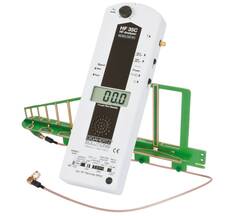
• Measuring range: 0.1 μW/m² up to 1,999 μW/m².
• Frequency range: 800 MHz up to 2,500 MHz.
• Accuracy: 6 dB, 9 digits.
• Identification of pulsed radiation sources (mobile radio: GSM, UMTS / G3, cordless telephones (DECT), WLAN (Bluetooth), radar surveillance stations, etc. by means of an acoustic signal proportional to the modulation frequency.
• Peak value as well as average value (switchable).
• Included in delivery: EMR meter device, attachable, direction-finding log.-per. antenna incl. antenna cable, Alkaline Mangan battery, detailed instruction manual (english), factual background information issuing "electric smog".
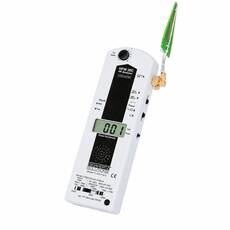
• Frequency range: 2.4-6 GHz
• Power flux density measurement range: 0.1-1999 uW/m2
• Peak and average value display with Full and Pulse measurement options
• Logarithmic-periodic measuring antenna with directional characteristics
• Audio analysis supports identification of pulsed radiation sources
• Quantitative differentiation of pulsed and unpulsed radiation
• 9 V alkaline manganese battery, average operating time: 6-7 hours
• Includes LogPer antenna, antenna cable, battery and detailed manual
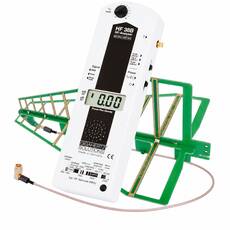
• Frequency range: 700 MHz-2.7 GHz, up to 3.3 GHz with increased tolerances
• Power flux density measurement range: 0.01-19,990 uW/m2
• Display resolution: 0.01 uW/m2
• Peak and average value display with Peak Hold function
• Optimized logarithmic-periodic measuring antenna
• Audio analysis supports identification of pulsed radiation sources
• 9 V alkaline manganese battery, average operating time: 6-7 hours
• Includes LogPer antenna, antenna cable, battery and operating instructions
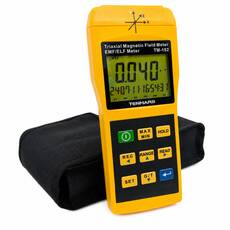
• ELF magnetic field measurement over a 30-2000 Hz frequency range
• Triaxial X, Y, Z sensor, measurement independent of measurement angle
• Ranges: 20/200/2000 mG and 2/20/200 uT
• Resolution: 0.01/0.1/1 mG or 0.001/0.01/0.1 uT
• Auto and manual range selection with HOLD, MAX and MIN functions
• Data logging memory with a capacity of 500 data sets
• 2.5 samples/second sample rate, time and calendar functions
• Includes user's manual, 9 V battery and carrying case
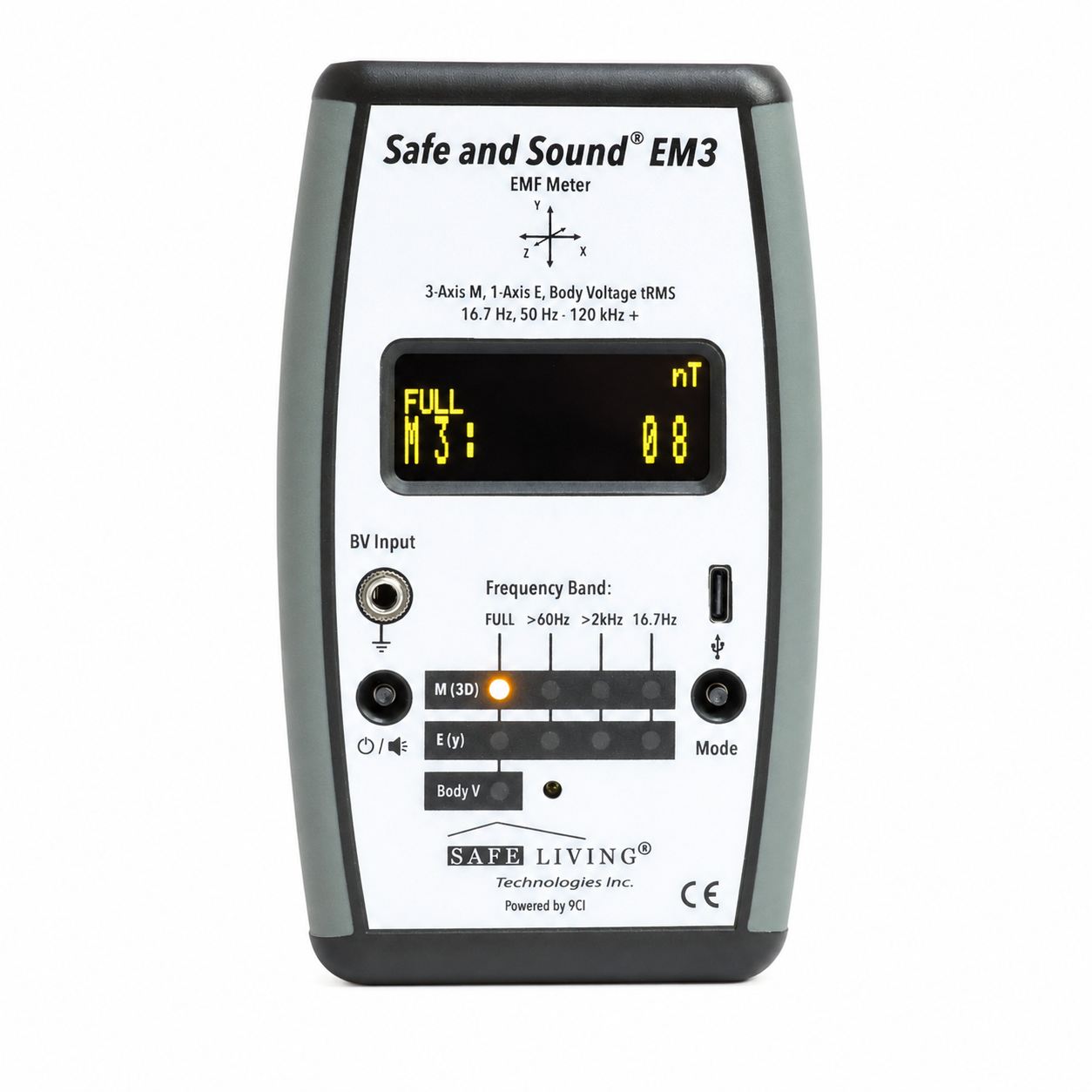
• Measures 3D AC magnetic, 1D AC electric fields and body voltage
• AC magnetic field: 16.7 Hz, 50 Hz-120 kHz, +/-1 dB
• AC electric field: 16.7 Hz, 50 Hz-400 kHz, +/-1 dB at 0.01-10 V/m
• Magnetic range: 0.01-100 mG per axis, max. 173 mG in 3D
• Body voltage: 1-12,000 mV, 50 Hz-120 kHz
• 16.7 Hz, >60 Hz, >2 kHz and FULL filters, RMS and PEAK modes
• Sound output and continuous operation via USB-C power
• Includes test leads, hand probe, grounding accessories and 2 AA batteries
What is electromagnetic pollution measurement, and what types of electromagnetic fields do we measure?
Electromagnetic pollution is an umbrella term describing man-made electromagnetic fields and radiation. During instrumental measurements, we treat low-frequency electric and magnetic fields separately from high-frequency electromagnetic radiation. The different frequency ranges require different measurement technologies, sensors, and evaluation methods. The primary goal of these measurements is to determine the extent to which individual sources contribute to the total electromagnetic exposure in a given environment.
How can electromagnetic radiation be classified by frequency range?
The electromagnetic spectrum ranges from a few hertz all the way up to gamma radiation. From the perspective of electromagnetic pollution measurements, the 50 Hz fields associated with low-frequency power systems, as well as the radio frequency and microwave ranges, are of primary importance. Radio communication systems, cellular networks, Wi-Fi devices, and Bluetooth connections typically operate in the frequency range from a few hundred MHz to several GHz. As frequency increases, the requirements for measurement methodology and the measuring instruments used also change significantly.
What types of electromagnetic sources are present in the modern environment?
In the modern built environment, electromagnetic exposure can originate from a variety of sources. Mobile communication systems, wireless local area networks, IoT devices, DECT technologies, radio and television transmitters, and smart building automation systems all contribute to the formation of radio frequency background levels. At the same time, electrical grids, switching power supplies, inverters, and high-current equipment generate low-frequency electric and magnetic fields.
Which physical quantities can be measured during electromagnetic pollution tests?
Measurement results can be expressed in terms of several different physical quantities. Electric field strength is typically given in V/m, while magnetic fields can be characterized using A/m, Tesla, or Gauss. During radiofrequency measurements, power density is often measured in W/m² or µW/m². Under specific conditions, there is a mathematical relationship between the different units of measurement, which allows for the comparison and interpretation of different measurement results.
What does measuring electric field strength mean?
Electric field strength indicates the force that would act on a unit charge at a given point in space. During electromagnetic pollution measurements, the magnitude of the electric field is examined using special sensors and isotropic probes. The measured values can be significantly influenced by conductive surfaces, building structures, and electrical equipment in the environment. Therefore, the selection of measurement points and adherence to standard measurement procedures are crucial.
How is magnetic field strength measured?
Measuring magnetic fields is particularly important in the vicinity of electrical power distribution systems, transformers, cable routes, and high-current equipment. Measuring instruments typically feature three-axis sensors that allow for the complete determination of the field vector. The analysis of low-frequency magnetic fields often requires different instruments than those used to measure radiofrequency emissions.
What is the role of power density measurement?
When evaluating radiofrequency radiation, power density is often used as a reference value. It indicates the amount of electromagnetic energy passing through a given surface per unit of time. Power density is one of the most important evaluation parameters when testing high-frequency communication systems, base stations, and radio transmitters.
What instruments are used to measure electromagnetic pollution?
In professional measurement practice, broadband radiation meters, frequency-selective analyzers, spectrum analyzers, and various measurement antennas can be used. The choice of instrument is always determined by the measurement objective, the frequency range, and the required accuracy. Handheld instruments intended for public use can provide quick on-site information, while laboratory and regulatory measurements require significantly higher accuracy.
How can a spectrum analyzer be used in electromagnetic testing?
The spectrum analyzer is one of the most important tools for the detailed analysis of the radio frequency environment. With its help, not only can the total radiation level be determined, but individual frequency components can also be isolated. This makes it possible to determine whether a given signal is caused by a cellular network, a Wi-Fi system, a radio transmitter, or other communication equipment. Frequency-selective measurement provides a significantly more accurate picture than broadband-only measurements.
What types of antennas are required for radio frequency measurements?
The accuracy of measurement results is largely determined by the type of antenna used. Broadband isotropic antennas are suitable for general environmental measurements, while directional antennas allow for the localization of individual radiation sources. Log-periodic, biconical, and horn antennas can be used in different frequency ranges and serve different measurement purposes.
Why is calibrating the measuring instrument so important?
The use of a calibrated measuring instrument is a fundamental requirement for professional electromagnetic pollution measurement. Calibration ensures that the results provided by the instrument comply with reference values and applicable standards. Without calibration, measurement uncertainty can increase significantly, which also reduces the reliability of the evaluation.
How is frequency-selective analysis of the radio frequency environment performed?
During frequency-selective measurement, the entire electromagnetic spectrum is divided into smaller frequency bands. This allows for the separation of different radio services, such as GSM, LTE, 5G, Wi-Fi, or PMR systems. This method is particularly useful when it is necessary to precisely identify a source of interference or excessive load at a specific frequency.
What EMC considerations arise during electromagnetic pollution measurements?
When testing electromagnetic compatibility, the focus is not solely on human exposure. The purpose of EMC measurements is to verify that electronic systems function properly in their electromagnetic environment and do not cause interference to other equipment. This is a fundamental requirement in the design of telecommunications and industrial systems.
What standards and recommendations are used for the evaluation?
International and national standards are applied when evaluating the results of electromagnetic pollution measurements. Of particular importance are the ICNIRP recommendations, the IEC and EN standards, and domestic regulations regarding electromagnetic exposure. When preparing professional measurement reports, the applicable standard system and measurement uncertainty must always be specified.
How should measurement results be interpreted in a professional context?
Measurement results rarely provide a complete picture on their own. During evaluation, the frequency range, measurement geometry, environmental reflections, temporal variations, and the operating status of radiation sources must be taken into account. The purpose of professional interpretation is to determine how the measured values relate to the operation of the given system and the relevant requirements.
What criteria should be considered when selecting a professional measuring instrument?
The primary considerations when selecting the appropriate measuring instrument are the frequency range, measurement dynamic range, sensitivity, and calibratability. It is also important to take into account the application environment, documentation capabilities, and future expandability. For professional use, it is advisable to choose a measurement system that is compatible with various antennas and suitable for performing both broadband and frequency-selective measurements.
Accurate assessment of the electromagnetic environment requires appropriate measuring instruments, professional measurement methodology, and a reliable technical infrastructure. Whether it involves measuring radiofrequency radiation, analyzing electric and magnetic fields, or selecting professional measuring equipment, DND Telecom Center is at your service with nearly three decades of telecommunications experience.
Our team of experts will help you navigate the range of instruments, antennas, measurement solutions, and shielding technologies related to electromagnetic pollution measurement so that you can select the tools best suited to your specific task.
Contact us and request our expert advice on selecting the measuring instruments and solutions needed for electromagnetic pollution measurement! As a partner of DND Telecom Center, you can count on reliable products, expert support, and a technical infrastructure you can rely on in the long term.