

Icom Handheld Airband Transceiver Radio
Icom handheld airband transceivers are designed for VHF aviation communication, with a 118.000-136.992 MHz COM transmit range, AM operation and 8.33/25 kHz channel spacing. The category includes COM, Bluetooth-capable and NAV+COM versions. The documented RF output power is 6 W PEP / 1.8 W carrier, while memory capacity varies between 200 and 300 channels depending on the version. The radios also provide a full keypad, a dedicated 121.5 MHz emergency frequency button, ANL noise reduction and Side Tone functionality. Read more...
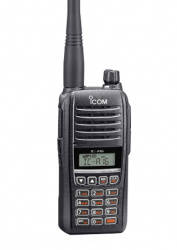
• VHF airband radio
• 1500mW loud audio provides clear communication
• Output power: 6W (PEP), 1.8W (carrier)
• 8.33kHz / 25kHz dual channel spacing
• Full keypad
• Easy to use while flying
• 200 programmable memory channels, 10 memory banks
• Side tone function, ANL Auto Noise Limiter, built-in VOX function
• Confirms with IP67/54 dust and water resistant protection
• Equivalent to MIL-STD 810 C, D, E, and F requirements
• LCD and key backlight for night time operation
• BNC type antenna connector

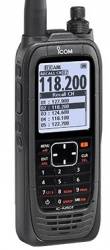
• VHF airband radio
• COM channels
• Maximum 6,0/1,8W RF output power (PEP/carrier)
• 8.33kHz / 25kHz dual channel spacing
• Large, alphanumeric LCD display
• Full keypad
• 300 programmable memory channels / 15 groups
• Confirms with IP57 standard (dustprotection and waterproof protection) (1 meter depth for 30 minutes)
• Basic package include: BP-288 Li-ion battery, BC-224 rapid charger, FA-B02AR antenna, MB-133 belt clip, handstrap (no BP-289 battery case, no OPC-2379 headset adapter cable)

• VHF airband radio
• NAV+COM channels
• GPS and Bluetooth functions
• Maximum 6,0/1,8W RF output power (PEP/carrier)
• 8.33kHz / 25kHz dual channel spacing
• Large, alphanumeric LCD display
• Full keypad
• 300 programmable memory channels / 15 groups
• Confirms with IP57 standard (dustprotection and waterproof protection) (1 meter depth for 30 minutes)
Icom handheld airband transceiver for VHF aviation communication
The COM versions of the Icom airband radios transmit and receive between 118.000 and 136.992 MHz. The NAV+COM version uses the same 118.000-136.992 MHz transmit range but covers 108.000-136.992 MHz for reception. The radios are designed for 50 ohm antenna systems and use a BNC antenna connector. The documented operating temperature range of the European versions is -20 to +55 C.
How does an airband radio operate in the 118.000-136.992 MHz COM band?
The aviation radio supports AM voice communication with 8.33 kHz and 25 kHz channel spacing. The full keypad allows direct frequency entry, while the PTT button is used to initiate transmission. The documented RF output power is 6 W PEP / 1.8 W carrier. The illuminated display and keypad support the presentation of operating information.
AM aviation radio with ANL noise reduction and Side Tone
ANL, or Auto Noise Limiter, is used to reduce noise during reception. When an aviation headset is connected, the Side Tone function feeds the operator's own transmitted voice back into the headset. The radios also support internal VOX operation, allowing voice-activated transmission with a compatible headset. On selected handheld versions, the internal speaker has a typical documented audio output of 1500 mW.
How can the 121.5 MHz emergency frequency be accessed directly?
A dedicated 121.5 MHz button on the full keypad provides direct access to the emergency frequency. The radios also support Scan, while the large-display COM and NAV+COM versions provide Priority Watch, VFO Scan, Memory Channel Scan and Priority Scan. The channel recall function stores the 10 most recently used channels.
200 and 300 memory channels in Icom handheld airband radios
The compact version supports 200 memory channels, while the large-display COM and NAV+COM versions provide 300 memory channels and 15 memory groups. On the latter versions, a 12-character name can be assigned to each memory channel. The 2.3-inch high-contrast LCD displays the operating frequency using large characters and also supports a dedicated night display mode.
What is the difference between COM and NAV+COM handheld airband transceivers?
The COM version handles communication channels between 118.000 and 136.992 MHz. The NAV+COM version extends reception down to 108.000 MHz and also provides VOR navigation functions. CDI displays deviation from the selected course, OBS is used to select a course, TO-FROM indication shows the relationship between the aircraft and the selected course, while ABSS allows the current course to be set as a new course.
GPS, GLONASS and SBAS navigation in a handheld airband radio
The NAV+COM version includes a built-in GPS receiver and supports GLONASS and SBAS. Waypoint NAV can be used with current position information, together with Direct-To NAV and Flight Plan NAV functions. Up to 10 flight plans and 300 waypoints can be stored. Near Station Search identifies nearby ground stations stored in memory with GPS position information.
How can Bluetooth and an aviation headset be used?
Bluetooth is built into the appropriate versions. The NAV+COM version can be used with a wireless headset, and Side Tone is also available with a compatible Bluetooth headset. Flight plans, Direct-To NAV data and waypoint information can be transferred from Android and iOS flight planning applications via Bluetooth. The specified headset adapter can be used to connect a wired aviation headset.
IP67, IP54 and IP57 protection on Icom aviation radios
The compact handheld version is specified with IP67/IP54 ratings and MIL-STD-810G test compliance. IP67 provides dust-tight and water-resistant protection, while IP54 provides protection against dust and splashing water when the specified accessories are fitted. The large-display COM and NAV+COM versions have an IP57 rating; the documented water-resistance test specifies immersion at a depth of 1 metre for 30 minutes.
How do battery operating time and charging differ?
The BP-280 Li-ion battery used by the 200-memory version has a typical capacity of 2400 mAh and a minimum capacity of 2280 mAh. A documented operating time of 17 hours is specified using a typical 5:5:90 transmit, receive and standby duty cycle. The 300-memory version uses a BP-288 battery with a typical capacity of 2350 mAh and a minimum capacity of 2200 mAh, with a documented operating time of up to 10.5 hours. The BP-288 can be charged in approximately 3 hours using the rapid charger.
Dimensions, weight and audio specifications of Icom handheld aviation radios
The compact version measures 52.2 x 111.8 x 34.1 mm with the BP-280 battery and weighs approximately 257 g. The large-display version measures 58.9 x 148.4 x 31.8 mm and weighs approximately 384 g with antenna and battery. The compact version has a documented typical internal speaker output of 1500 mW, while the large-display version provides more than 350 mW of audio output.
What are the advantages and limitations of Icom aviation communication?
- Advantage: 118.000-136.992 MHz COM operation with 8.33/25 kHz channel spacing.
- Advantage: 6 W PEP / 1.8 W carrier RF output power and a full keypad.
- Advantage: depending on the version, Bluetooth, GPS, VOR, Direct-To NAV and Flight Plan NAV are available.
- Limitation: NAV, GPS and Bluetooth functions are not available on every version.
- Limitation: operation requires an appropriate radio licence and the radio may require programming.
When selecting a radio, COM or NAV+COM operation, memory capacity, Bluetooth requirements, protection rating, battery operating time and aviation headset connection should therefore be considered together.
Frequently asked questions about Icom handheld airband transceivers
- What is the transmit frequency range?
The documented COM transmit range is 118.000-136.992 MHz. - Which channel spacing options are supported?
8.33 kHz and 25 kHz channel spacing are supported. - Is there a direct emergency frequency button?
Yes. A dedicated 121.5 MHz button is provided on the full keypad. - Do all versions include GPS and Bluetooth?
No. These functions are only available on the relevant versions. - Which antenna connector is used?
The documented handheld radios use a 50 ohm BNC antenna connector. - Is a radio licence required?
Yes. Operation of an airband radio requires an appropriate radio licence, and the radio may also require programming.
Summary for selecting an Icom handheld airband transceiver
We recommend first deciding whether you need COM communication only or NAV+COM functions as well. You can then compare 200 or 300 memory channels, Bluetooth connectivity, GPS and VOR navigation, IP67/IP54 or IP57 protection and battery operating time. The common technical basis of the category is AM aviation communication, the 118.000-136.992 MHz COM range, 8.33/25 kHz channel spacing and 6 W PEP / 1.8 W carrier RF output power.