

Electrosmog Shielding Paint
Electrosmog-shielding paint is a special coating that can help reduce the propagation of radiofrequency radiation inside buildings. Due to the increasing density of Wi-Fi networks, mobile communication systems, and wireless devices, many people are seeking technical solutions to mitigate electromagnetic exposure. When properly selected and professionally applied, shielding paint can significantly reduce radiation levels in residential buildings, offices, or specialized technical environments. Read more...
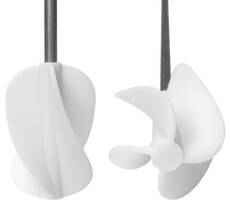
• Stirrer Size: 42 mm x 60 mm
• Bar lenght: Stainlesss steel 33 cm
• To mix up our containers with the small 42 mm opening.

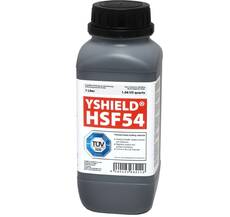
• Standard paint with the best all-round properties
• Up to 90 dB at 40 GHz
• TÜV-SÜD certified
• Screening attenuation at 1 GHz: single layer 44 dB | double layer 53 dB | three layer 60 dB
• Reccommended use quantity: 4 m2/l
• For interior and exterior use
• 1 liter package
• Paint color: black


• Standard paint with the best all-round properties
• Up to 90 dB at 40 GHz
• TÜV-SÜD certified
• Screening attenuation at 1 GHz: single layer 44 dB | double layer 53 dB | three layer 60 dB
• Reccommended use quantity: 4 m2/l
• For interior and exterior use
• 5 liter package
• Paint color: black
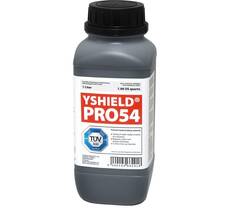
• Special paint using carbon fibres
• Up to 90 dB at 40 GHz
• TÜV-SÜD certified
• Screening attenuation at 1 GHz: single layer 43 dB | double layer 49 dB | three layer 55 dB
• Reccommended use quantity: 4 m2/l
• For interior and exterior use
• 1 liter package
• Paint color: black

• Special paint using carbon fibres
• Up to 90 dB at 40 GHz
• TÜV-SÜD certified
• Screening attenuation at 1 GHz: single layer 43 dB | double layer 49 dB | three layer 55 dB
• Reccommended use quantity: 4 m2/l
• For interior and exterior use
• 5 liter package
• Paint color: black

• Special paint with a focus on long storage suitability
• Up to 84 dB at 40 GHz
• TÜV-SÜD certified
• Screening attenuation at 1 GHz: single layer 36 dB | double layer 41 dB | three layer 46 dB
• Reccommended use quantity: 4 m2/l
• For interior and exterior use
• 3 liter package
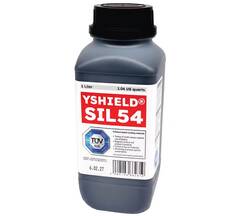
• Electrically conductive indoor shielding paint without preservatives
• HF shielding: 600 MHz-40 GHz, shielding of LF electric fields
• Shielding attenuation at 4 m2/l: 44 dB one layer, 53 dB two layers
• Shielding attenuation at 8 m2/l: 35 dB one layer, 44 dB two layers
• Coverage: 4-8 m2/l per layer
• Black, density 1.29 kg/l, viscosity 9000 mPas
• TÜV-SÜD TM-09 certification, VOC content: 0.00 g/l
• Container size: 1 liter
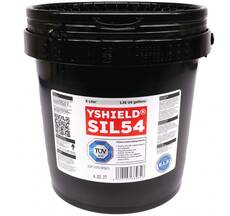
• Electrically conductive indoor shielding paint without preservatives
• HF shielding: 600 MHz-40 GHz, shielding of LF electric fields
• Shielding attenuation at 4 m2/l: 44 dB one layer, 53 dB two layers
• Shielding attenuation at 8 m2/l: 35 dB one layer, 44 dB two layers
• Coverage: 4-8 m2/l per layer
• Black, density 1.29 kg/l, viscosity 9000 mPas
• TÜV-SÜD TM-09 certification, VOC content: 0.00 g/l
• Container size: 5 liters
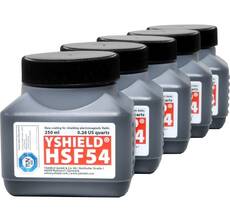
• Sample set of our HF shielding paints HSF54, MAX54, PRO54, HSF64
• Content: 4x250ml
• Weight: 1600 g
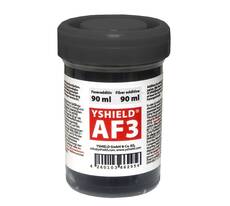
• For the following shielding paints: MAX54, PRO54, HSF54, HSF64, NSF34
• In the event of cracks forming in the substrate, this additive contains long, electrically conductive carbon fibers that ensure grounding without the use of a grounding strap.
• Coverage: Mix with 5 liters of shielding paint
• Ingredients: Water, carbon fibers, additives, preservative
• Quantity: 90ml
• Weight: 110 g
• Color: Black
• Frost resistant

• For priming solid old paint layers, brittle, chalky and absorbent substrates
• Content: 1 liter
• Weight:1300 g
• Dilution rate: Mix 1 litre of primer with 4 litres of water
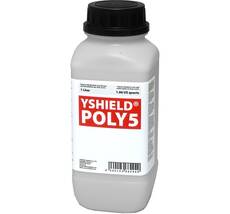
• Type: acrylate polymer additive
• Increases conductivity – reduces the electrical resistance of the coating
• Increases adhesion – better bonding between the surface and the paint
• Increases film hardness – more durable shielding layer
• Applicable paints: HSF54, MAX54, PRO54, NSF34, IR-2, IR-5, IR-10, and DRY54
• Package: 1 liter
• Recommended ratio: 1%–50% relative to the volume of paint
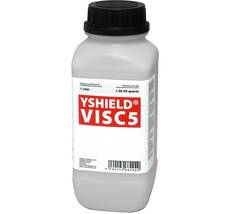
• Type: Polyurethane-based thickening additive
• Increases viscosity – helps to create thicker layers
• Suitable for screen printing or special application techniques
• Compatible paints: HSF54, MAX54, PRO54, NSF34, IR-2, IR-5, IR-10
• Packaging: 1 liter
• Recommended dosage: ~0.1%–2.0% relative to the volume of ink
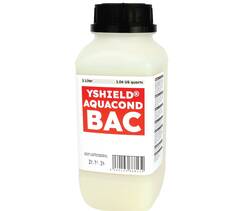
• YSHIELD AQUACOND BAC is a water-based pure acrylate dispersion
• It is a modern high-end binding agent with universal adhesion to almost all substrates
• MFFT (minimum film formation temperature): 0°C
• Viscosity: 4000 mPas
• PH value: 8
• Density: 1.02 kg/l
• Solid content: 43 %
• VOC content: 0 g/l
• Frost and thaw resistance: 5 cycles
• Weight: 1,5 kg
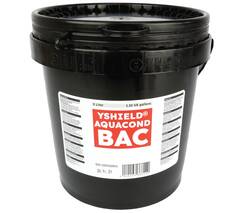
• YSHIELD AQUACOND BAC is a water-based pure acrylate dispersion
• It is a modern high-end binding agent with universal adhesion to almost all substrates
• MFFT (minimum film formation temperature): 0°C
• Viscosity: 4000 mPas
• PH value: 8
• Density: 1.02 kg/l
• Solid content: 43 %
• VOC content: 0 g/l
• Frost and thaw resistance: 5 cycles
• Weight: 7 kg
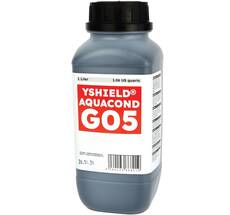
• YSHIELD AQUACOND G05 is a water-based dispersion of natural graphite with an average particle diameter of 5 µm and carbon black
Dispersing additive: Nonionic
• G05 Pigment: Natural graphite d50 = 5 µm; d90 = 10 µm; in combination with our AQUACOND BAC binding agent, resistances from 5 ohms can be achieved
• Viscosity: 2800 mPas
• PH value: 6.1
• Density: 1.31 kg/l
• Solid content: 39.5 %
• VOC content: 0 g/l
• Ingredients: Water, natural graphite, carbon black, additives, preservative BIT/INN. Water-soluble without additional binding agent
• Weight: 1,5 kg
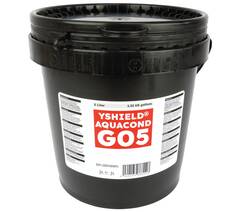
• YSHIELD AQUACOND G05 is a water-based dispersion of natural graphite with an average particle diameter of 5 µm and carbon black
Dispersing additive: Nonionic
• G05 Pigment: Natural graphite d50 = 5 µm; d90 = 10 µm; in combination with our AQUACOND BAC binding agent, resistances from 5 ohms can be achieved
• Viscosity: 2800 mPas
• PH value: 6.1
• Density: 1.31 kg/l
• Solid content: 39.5 %
• VOC content: 0 g/l
• Ingredients: Water, natural graphite, carbon black, additives, preservative BIT/INN. Water-soluble without additional binding agent
• Weight: 1,5 kg
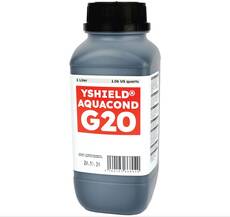
• YSHIELD AQUACOND G20 is a water-based dispersion of natural graphite with an average particle diameter of 20 µm and carbon black
Dispersing additive: Nonionic
• G05 Pigment: Natural graphite d50 = 20 µm; d90 = 50 µm; in combination with our AQUACOND BAC binding agent, resistances from 5 ohms can be achieved
• Viscosity: 2400 mPas
• PH value: 6.9
• Density: 1.32 kg/l
• Solid content: 39.5 %
• VOC content: 0 g/l
• Ingredients: Water, natural graphite, carbon black, additives, preservative BIT/INN. Water-soluble without additional binding agent
• Weight: 1,5 kg
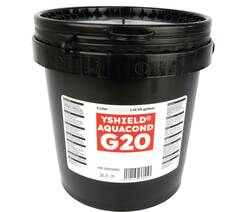
• YSHIELD AQUACOND G20 is a water-based dispersion of natural graphite with an average particle diameter of 20 µm and carbon black
Dispersing additive: Nonionic
• G05 Pigment: Natural graphite d50 = 20 µm; d90 = 50 µm; in combination with our AQUACOND BAC binding agent, resistances from 5 ohms can be achieved
• Viscosity: 2400 mPas
• PH value: 6.9
• Density: 1.32 kg/l
• Solid content: 39.5 %
• VOC content: 0 g/l
• Ingredients: Water, natural graphite, carbon black, additives, preservative BIT/INN. Water-soluble without additional binding agent
• Weight: 7 kg
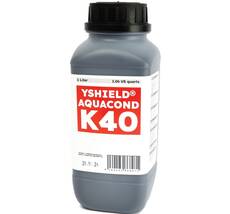
• YSHIELD AQUACOND K40 is a water-based dispersion of a hard carbon pigment with an average particle diameter of 40 µm and carbon black
• In combination with a binding agent, square resistances from 10 ohms are possible
• Dispersing additive: Nonionic
• K40 pigment: Carbon pigment d50 = 40 µm; d90 = 60 µm; in combination with our AQUACOND BAC binding agent, resistances from 10 ohms can be achieved.
• Viscosity: 3000 mPas
• PH value: 6.3
• Density: 1.42 kg/l
• Solid content: 54.5 %
• VOC content: 0 g/l
• Ingredients: Water, carbon pigment, carbon black, additives, preservative BIT/INN. Water-soluble without additional binding agent.
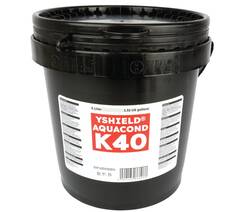
• YSHIELD AQUACOND K40 is a water-based dispersion of a hard carbon pigment with an average particle diameter of 40 µm and carbon black
• In combination with a binding agent, square resistances from 10 ohms are possible
• Dispersing additive: Nonionic
• K40 pigment: Carbon pigment d50 = 40 µm; d90 = 60 µm; in combination with our AQUACOND BAC binding agent, resistances from 10 ohms can be achieved.
• Viscosity: 3000 mPas
• PH value: 6.3
• Density: 1.42 kg/l
• Solid content: 54.5 %
• VOC content: 0 g/l
• Ingredients: Water, carbon pigment, carbon black, additives, preservative BIT/INN. Water-soluble without additional binding agent.
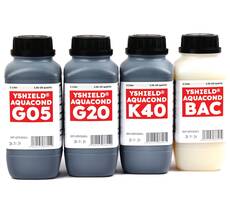
• Sample set of Aquacond primers: G05, G20, K40, BAC
• Packaging: 4 x 1 L
• Weight: 6 kg
What is electromagnetic interference shielding paint, and what is it used for?
Electromagnetic interference shielding paint is a coating containing conductive components that can reduce the penetration of radiofrequency signals through building structures. Such paints are primarily used on walls, ceilings, and, in some cases, other building surfaces.
The goal is not to completely block the signals, but to significantly attenuate them. This can be particularly useful in places where high-intensity external radiation sources are located nearby. Modern shielding paints are formulated to be applied in the same way as conventional interior coatings, while providing professional-grade shielding properties.
What types of electromagnetic radiation can they protect against?
Shielding paints are primarily designed to reduce high-frequency electromagnetic radiation. This includes frequencies used by cellular networks, Wi-Fi networks, LTE and 5G technologies, as well as numerous other radio-frequency communication systems.
Actual shielding performance always depends on the frequency range, the number of applied layers, the surface design, and the quality of workmanship. For this reason, it is advisable to consider independent laboratory tests in addition to the manufacturer’s data.
How does a conductive shielding coating work?
Conductive paints contain special carbon-based or other conductive components. These particles form a continuous layer on the surface that is capable of attenuating or reflecting a portion of electromagnetic waves.
Shielding performance is typically expressed in decibels (dB). A higher dB value indicates greater radiation reduction. In practice, however, it is not just the paint itself that matters, but also the entire building structure, the windows and doors, the floors, and the quality of construction.
Why is interest in EMF protection growing?
Along with the rapid development of wireless technologies, the number of devices emitting electromagnetic radiation has also increased. In modern homes and workplaces, multiple Wi-Fi networks, cell phones, smart devices, and wireless communication systems operate simultaneously.
As a result, more and more people are seeking technical solutions that allow for better control of radiofrequency exposure in their environment. This is precisely why shielding paints have become one of the best-known building services solutions for EMF protection.
In what types of rooms can electromagnetic pollution shielding paint be used?
Electrosmog-shielding paint can be used in a variety of settings. In residential properties, it is often used in bedrooms and home offices, where reducing radiofrequency exposure from wireless communication systems is a key consideration.
In offices, it can also be used around workstations, conference rooms, and executive offices. It is also a common solution in technical rooms, near data communication systems, and in specialized industrial environments. The use of shielding paint may also be considered for certain healthcare or research projects.
To determine the appropriate area of application, it is advisable to assess the local electromagnetic environment and sources of radiation in advance.
How can the effects of Wi-Fi radiation and cellular network signals be reduced?
The best results are generally not achieved by using a single product. It is important to identify the sources of radiation, determine the surfaces to be shielded, and uncover any potential weak spots.
In addition to treating walls, it may often be necessary to shield doors, windows, cable runs, or other structural elements. Shielding paint, when combined with proper grounding and supplementary shielding solutions, can ensure the best results.
What are the benefits of YSHIELD HSF54 shielding paint?
YSHIELD HSF54 is one of the best-known professional shielding paints in Europe. The product is water-based, has a low VOC content, and provides shielding performance across a wide frequency range.
Based on independent tests, it ranks among the strongest performers in its category and has achieved outstanding results in several key parameters. Another advantage is that the manufacturer provides a complete grounding system and detailed technical documentation to ensure professional installation.
What do independent laboratory tests show?
A comparative technical study published in 2022 tested 19 different shielding products. The research examined shielding performance, adhesion strength, VOC emissions, and grounding options.
The YSHIELD HSF54 demonstrated outstanding shielding performance during the tests, while also featuring low VOC content and high adhesion strength. The study also specifically highlighted the manufacturer’s detailed grounding documentation and professional accessory system.
Why is it important to install a proper grounding system?
For conductive shielding paints, grounding is not merely recommended—it is one of the most important elements of the system. Proper grounding can help optimize shielding performance and ensure safe operation.
According to industry recommendations, grounding work must always be performed by a qualified electrician. Improper grounding can reduce shielding effectiveness and adversely affect system operation.
How is electromagnetic interference (EMI) shielding paint applied?
The application process is similar to that of conventional interior paints. The first step is to clean the surface, repair it if necessary, and prepare it.
Next, the paint must be applied at the film thickness specified by the manufacturer. In many cases, applying two coats is recommended to achieve the desired shielding performance. It is always advisable to determine the exact material requirements and technical specifications based on the technical data sheet.
On what surfaces can the shading coating be applied?
Shading paints are generally well-suited for use on plastered walls, drywall surfaces, concrete walls, and properly prepared building panels. It is important that the substrate be stable, clean, and have adequate load-bearing capacity.
The quality of the surface can significantly affect adhesion and long-term performance, so it is always advisable to check the condition of the substrate before application.
What factors should we consider when choosing a shading paint?
When selecting a shading paint, the first thing to examine is its shading performance. Laboratory test results help compare different products and provide a realistic picture of the expected results.
Other important factors include VOC content, coverage, ease of application, and the availability of grounding systems. It’s advisable to choose a manufacturer that provides detailed technical documentation, test results, and professional support.
For professional users, long-term availability and the provision of compatible accessories may be particularly important.
When is it advisable to combine the paint with a shading net or other accessories?
In certain situations, the paint alone may not provide a comprehensive solution. For large glass surfaces, special structural connections, or situations requiring enhanced shading, it may be advisable to use shading screens, films, or other supplementary systems.
Complex shading projects generally work most effectively when different solutions complement each other to form a unified system.
What common mistakes should be avoided during installation?
The most common mistakes include inadequate surface preparation, insufficient coating thickness, improper grounding, and failure to follow the manufacturer’s specifications.
It can also cause problems if an incompatible topcoat is used during application or if the recommended amount of material is not applied. These mistakes can significantly reduce shielding performance.
Who should use electromagnetic shielding paint?
Electromagnetic shielding paint is an ideal choice for private individuals, offices, technical specialists, network installation projects, and specialized industrial users alike.
We recommend it to those seeking a long-term, professional solution for reducing radiofrequency radiation and who value documented technical performance.
Why should you purchase shielding materials from an expert source?
When it comes to shielding systems, technical support and proper documentation play a key role alongside product quality. We recommend choosing a supplier that not only provides the materials but also offers professional assistance with installation.
Selecting the right product, establishing the correct layer sequence, and ensuring proper grounding all work together to deliver the performance you can expect from a professional electromagnetic interference shielding system.
The effectiveness of electromagnetic interference shielding does not depend solely on the paint. Choosing the right product, determining the necessary level of shielding, and ensuring proper grounding and installation all play an important role in the final result.
DND Telecom Center has been providing professional technical solutions and expert support to its customers for over 25 years. If you’re unsure which shielding paint is best suited for your specific environment, or if you need help planning the installation, our team of experts is happy to assist you.