

- Special Offers
- Transceiver Radio
- Walkie-Talkies
- CB Radios
- Two-Way Transceiver Radio
- Two-Way Radio Repeater
- ATEX Intrinsically Safe Radio
- POC Radios
- Amateur Radio
- Communication Receiver
- Icom Handheld Scanner and Communication Radio Receiver
- Icom Mobile and Base Station Scanner, Communication Radio Receiver
- Albrecht Scanner and Receiver Radio
- Aviation Radio
- Marine Radio
- AIS Transponder
- Marine Radar
- Satellite Phone
- WiFi Two-Way Radio
- TourGuide System
- Data Transceiver
- Transceiver Accessory
- Antennas
- Antenna Accessory
- Fiber Optics
- Cable
- Connector
- Installation Material
- Installation Tools
- Measuring Equipement
- Body Worn Camera
- Electrosmog
- Telephone
- Baby Monitor
- Fever Thermometer
- Radio Device
- Set-top Boxes
- Personal Protective Equipment
- Motorcycle Helmet Speaker
- Car Equipment
- Voltage Converter
- Dry Cell
- Battery
- Battery Charger
- Emergency Signal
- Amber Signal
- Sound Signal
- Light and Sound Signal Accessory
- Traffic Engineering
- LED Lamp
- Smart Home
- Mosquito Repellent Device
- Market - Other Products
- Discontinued Products
Pre-order (1)
Icom Mobile and Base Station Scanner, Communication Radio Receiver
The Icom communications receiver category offers a desktop radio receiver for wideband radio-frequency reception. In addition to a reception range from 10 kHz to 3 GHz, it provides analogue and digital reception modes, memory management, multiple scanning functions, a real-time spectrum display, SD card audio recording and computer-based remote control. Read more...
Pre-order (1)
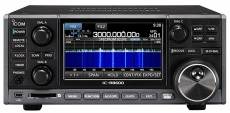
• 0.010 - 3000.000MHz frequency coverage
• LSB / USB / CW / FSK / AM / FM / WFM mode
• P25, D-STAR, NXDN, dPMR, DCR digital mode
• 2000 memory channel
• 1Hz channel spacing
• 4,3 inch wide colour LCD display
• SD card, USB interface
• ±0.5ppm high frequency stability
• Multi-function high performance spectrum scope
• Icom's high-end base station communication receiver
• Icom AD-55NS power supply and 230V adapter is not supplied accessorie

Icom communications receiver, mobile scanner and desktop radio receiver
The wideband receiver supports 1 Hz frequency tuning steps. Analogue reception modes include USB, LSB, CW, FSK, AM, FM and WFM, while digital modes include D-STAR, P25 Phase 1, NXDN, dPMR and DCR. Frequency stability is specified as less than +/-0.5 ppm at 25 degrees Celsius after warm-up.
What frequency range does the Icom communications receiver cover?
The documented EXP reception range is 0.010000-3000.000000 MHz. The receiver has three antenna connectors: Type-N 50 ohm for 0.01-3000 MHz, PL-259 50 ohm for 0.01-30 MHz and RCA 500 ohm for 0.01-30 MHz. This allows the use of antenna connections specified for different frequency ranges.
Analogue and digital reception modes in the wideband receiver
Demodulation and signal processing are performed using FPGA and DSP units. The system uses direct sampling together with a superheterodyne receiver architecture across different frequency ranges. RSSI indication is available in S-meter, dBu, dBu emf and dBm display modes.
How do the spectrum display and scanning functions help with signal searching?
The 4.3-inch colour touchscreen provides a real-time spectrum scope and waterfall display. Scanning functions include programmed scan, memory scan, selected memory scan, selected mode scan, auto memory write scan, priority scan and delta-f scan. During memory scanning, the documented speed is up to 100 channels per second.
Memory channels, SD card and USB on the desktop radio receiver
The receiver manages 2000 standard memory channels in 100 groups, together with auto-write memories, skip memories and scan-edge memories. Received audio can be recorded to an SD card in WAVE format, while screenshots can be saved in PNG or BMP format.
What remote-control options does the Icom communications receiver provide?
Optional PC remote-control software provides access to received audio and most receiver functions over an IP network or USB cable, including the spectrum scope. CI-V remote-control commands are also supported.
Frequently asked questions about Icom communications receivers
- What frequency range can be received?
The documented reception range of the EXP version is 10 kHz to 3 GHz. - Which digital modes are supported?
D-STAR, P25 Phase 1, NXDN, dPMR and DCR reception modes are supported. - Can received audio be recorded?
Yes. Audio can be recorded to an SD card in WAVE format. - Can the receiver be controlled from a computer?
Yes. With optional software, it can be remotely controlled over an IP network or USB connection.
Summary
The Icom communications receiver combines a wide 10 kHz-3 GHz reception range, analogue and digital reception modes, 2000 standard memory channels, real-time spectrum display, multiple scanning functions and SD card recording in a desktop format.