

- Special Offers
- Transceiver Radio
- Transceiver Accessory
- Antennas
- Antenna Accessory
- Fiber Optics
- Cable
- Connector
- Installation Material
- Installation Tools
- Measuring Equipement
- Body Worn Camera
- Electrosmog
- Telephone
- Baby Monitor
- Fever Thermometer
- Radio Device
- Set-top Boxes
- Personal Protective Equipment
- Motorcycle Helmet Speaker
- Car Equipment
- Voltage Converter
- Dry Cell
- Battery
- Battery Charger
- Battery Chargers
- Gel Battery Charger
- Alfatronix Battery Charger
- Victron Energy Battery Charger
- Dometic Battery Charger
- Dometic Work Battery Charger
- Mean Well Battery Charger
- Battery Guard
- Emergency Signal
- Amber Signal
- Sound Signal
- Light and Sound Signal Accessory
- Traffic Engineering
- LED Lamp
- Smart Home
- Mosquito Repellent Device
- Market - Other Products
- Discontinued Products
Pre-order (0)
Victron Energy Battery Charger
A Victron Energy battery combiner is used to connect and disconnect two batteries automatically in 12 V or 24 V electrical systems. The device monitors the voltage of the starter battery and the auxiliary battery, then connects or separates them according to the charging condition. This allows an alternator or another charging source to charge both batteries while preventing onboard loads from unnecessarily discharging the starter battery. Read more...
Pre-order (0)
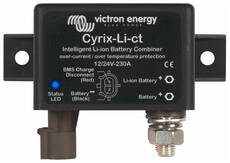
• Power consumption when open: < 4 mA
• Protection Class: IP54
• Voltage: 12 / 24 V
• Direct current and 12/24V cut-off capability: 230A
• Direct current and 48V cut-off capability: 80A
• Dimensions: 5 × 10 × 6,5 cm
• Weight: 1kg


Victron Energy battery combiner for dual-battery systems
A battery combiner can be used in vehicles, boats, and other onboard systems where separate batteries are installed for engine starting and auxiliary loads. The device is not a battery charger. It is an automatically controlled battery switch, while the charging energy is supplied by the alternator or another charger connected to the electrical system.
How does the intelligent battery switch operate?
The device continuously monitors the voltage of the connected batteries. When the voltage rises to a charging level, it connects the batteries so that the charging source can supply both. When the voltage decreases, the combiner opens the connection and separates the starter battery from the loads powered by the auxiliary battery.
Connecting the starter and auxiliary batteries
The purpose of a dual-battery system is to keep the energy required for engine starting separate from the power used by onboard equipment. Lighting, communication equipment, refrigeration appliances, or other connected loads can operate from the auxiliary battery while the starter battery remains isolated.
Operation in 12 V and 24 V battery systems
The battery combiner in this category can be used in both 12 V and 24 V systems. Before installation, the nominal system voltage, battery arrangement, expected current, cable dimensions, and fuse ratings must be checked.
Voltage sensing and automatic disconnection
Voltage-controlled automatic switching does not require continuous manual operation. The system connects the batteries during charging and separates them when the voltage falls to the disconnection level. This helps prevent auxiliary loads from discharging the starter battery.
230 A switching capacity and IP54 protection
The documented switching capacity is 230 A. The device has an IP54-rated enclosure, while its current consumption in the open state is below 4 mA. The installation location, cable cross-section, and overcurrent protection must be selected according to the electrical load of the system.
What should be checked when selecting a battery combiner?
- The nominal 12 V or 24 V voltage of the onboard system.
- The arrangement of the starter and auxiliary batteries.
- The maximum expected system current.
- The cross-section and length of the cables.
- The required fuses and connection components.
- The available mounting location.
The combiner must be selected as part of the complete electrical system. The connected batteries, cables, and protection devices must also meet the requirements of the installation.