

Magnetic Shielding
Magnetic shielding for reducing electrosmog can be implemented with materials designed to reduce low-frequency magnetic fields and, in some cases, high-frequency electromagnetic radiation. When selecting the appropriate shielding material, it is important to consider the frequency of the interfering field, the size of the area to be shielded and the number of material layers used. Read more...
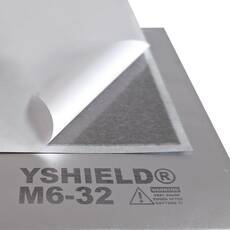
• Self-adhesive with groundable aluminum surface
• For small areas
• 20-33 dB shielding at 50 Hz
• Size: 29 cm x 21 cm
• Thickness: 0.6 mm
• Corresponds to that of aluminum
• Minimum bending radius: 20 cm
• Attenuation magnetic fields:
- Single-layer 20 dB (89.4 %)
- Two-layer 26 dB (94.8 %)
- Three-layer 30 dB (96.9 %)
- Four-layer 33 dB (97.7 %)
• Weight: 100 g

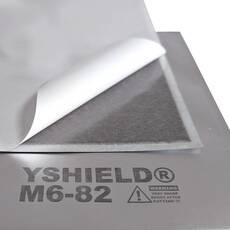
• Self-adhesive with groundable aluminum surface
• Universally applicable on small to very large surfaces
• 20-33 dB shielding at 50 Hz
• Size: 80 x 21 cm
• Thickness: 0.6 mm
• Corresponds to that of aluminum
• Minimum bending radius: 20 cm
• Attenuation magnetic fields:
- Single-layer 20 dB (89.4 %)
- Two-layer 26 dB (94.8 %)
- Three-layer 30 dB (96.9 %)
- Four-layer 33 dB (97.7 %)
• Weight: 270 g

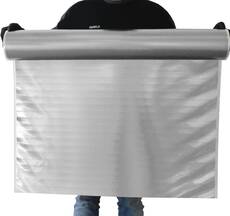
• M6L-9X is a magnetic field shielding film for shielding low frequency magnetic fields
• Highly resistant with laminating film on both sides, suitable as an intermediate layer in roof or floor constructions
• For this product, we have connected 6 very thin shielding foils together
• Attenuation magnetic fields (Three-phase 50 Hz): Single-layer 19.5 dB (89.4 %), two-layer 25.7 dB (94.8 %), three-layer 30.2 dB (96.9 %), four-layer 32.6 dB (97.7 %)
• Attenuation magnetic fields (Single-phase 50 Hz): Single-layer 17.7 dB (87 %), two-layer 23.2 dB (93.1 %), three-layer 26.8 dB (95.4 %), four-layer 29.3 dB (96.6 %)
• Attenuation magnetic fields (Static): DC consumers, earth magnetic field, permanent magnets are shielded in a range from 15 % (single-layer) to 58 % (four-layer)
• Minimum bending radius: 20 cm
• Width: 90 cm (Shielding surface); 94 cm (total product)
• Length: Available by the meter / 18 meter rolls
• Thickness: 1 mm
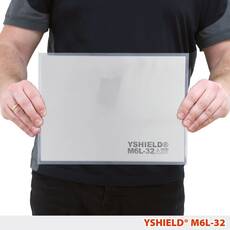
• Application using a stapler or nailer
• For small areas
• 20-33 dB shielding at 50 Hz
• Size: 29 cm x 21 cm
• Thickness: 0.6 mm
• Corresponds to that of aluminum
• Minimum bending radius: 20 cm
• Attenuation magnetic fields:
- Single-layer 20 dB (89.4 %)
- Two-layer 26 dB (94.8 %)
- Three-layer 30 dB (96.9 %)
- Four-layer 33 dB (97.7 %)
• Weight: 90 g
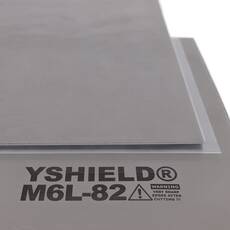
• Application using a stapler or nailer
• Universally applicable on small to very large surfaces
• 20-33 dB shielding at 50 Hz
• Size: 80 x 21 cm
• Thickness: 0.5 mm
• Corresponds to that of aluminum
• Minimum bending radius: 20 cm
• Attenuation magnetic fields:
- Single-layer 20 dB (89.4 %)
- Two-layer 26 dB (94.8 %)
- Three-layer 30 dB (96.9 %)
- Four-layer 33 dB (97.7 %)
• Weight: 240 g
• Application using a stapler or nailer
• Our largest possible type of this product
• 20-33 dB shielding at 50 Hz
• Size: 80 x 55 cm
• Thickness: 0.5 mm
• Corresponds to that of aluminum
• Minimum bending radius: 20 cm
• Attenuation magnetic fields:
- Single-layer 20 dB (89.4 %)
- Two-layer 26 dB (94.8 %)
- Three-layer 30 dB (96.9 %)
- Four-layer 33 dB (97.7 %)
• Weight: 640 g
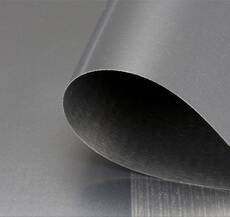
• to shield LF magnetic fields with 30 dB attenuation = 97 %
• Width: 61 cm
• Attenuation LF magnetic field: 30 dB (97 %); The attenuation depends on the number of phases, cable twisting, the size of the area, etc.
• Work in large areas: Shield cables with 1-2 sheets, fuse-boxes with 2-4 sheets;
• Attenuation HF: 70 dB
• Weight: 265 g/m²
• Material thickness: 0.1 mm
• Color: Silver
• Permeability: µ 2 = 10,000; µ 4 = 25,000; µ max. = 100,000;
• Saturation polarization Bs: 0.55 T
• Coercive field strength Hc: 0.5 A/m
• Remanence Br/Bs: 0.7
• Curie temperature Tc: 225 °C
• Materials: Polyester, Co, Fe, Mo, Nb, Si, B
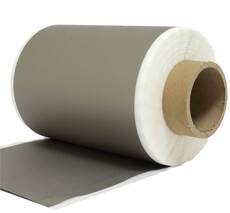
• M2L is a super-thin magnetic field shielding foil for shielding low-frequency magnetic fields
• For this product, we have bonded 2 layers of high-tech magnetic field shielding film and protected them on both sides with laminating film
• Highly resistant, suitable as an intermediate layer in roof or floor constructions
• Attenuation magnetic fields (Three-phase 50 Hz): Single-layer 12.1 dB (75.1 %), two-layer 16.3 dB (84.7 %), three-layer 19.5 dB (89.4 %), four-layer 21.7 dB (91.8 %)
• Attenuation magnetic fields (Single-phase 50 Hz): Single-layer 10.5 dB (70.1 %), two-layer 13.3 dB (78.3 %), three-layer 16.0 dB (84.1 %), four-layer 18.6 dB (88.2 %)
• Minimum bending radius: 10 mm
• Width: 21 cm (Shielding surface); 23 cm (total product)
• Length: Available by the meter / 100 meter rolls
• Thickness: 0.12 mm
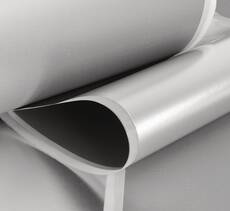
• M2A is a super-thin magnetic field shielding foil for shielding low-frequency magnetic fields
• For this product we have bonded 2 layers of high-tech magnetic field shielding foil
• Attenuation high frequency: 125 dB
• Attenuation magnetic fields (Three-phase 50 Hz): Single-layer 12.1 dB (75.1 %), two-layer 16.3 dB (84.7 %), three-layer 19.5 dB (89.4 %), four-layer 21.7 dB (91.8 %)
• Attenuation magnetic fields (Single-phase 50 Hz): Single-layer 10.5 dB (70.1 %), two-layer 13.3 dB (78.3 %), three-layer 16.0 dB (84.1 %), four-layer 18.6 dB (88.2 %)
• Minimum bending radius: 10 mm
• Width: 21 cm (Shielding surface); 24 cm (total product)
• Thickness: 0.12 mm
Magnetic shielding for reducing electrosmog
The purpose of magnetic shielding materials is to reduce the strength of the magnetic field passing through the material. Shielding effectiveness is expressed in decibels. A higher decibel value indicates greater attenuation, but the result always relates to the specific measuring conditions, frequency range and number of layers.
Low-frequency magnetic fields and high-frequency electromagnetic waves are not the same physical phenomenon. For this reason, shielding values measured in different frequency ranges cannot be compared directly. The first step is always to determine which type of electromagnetic field needs to be reduced.
Which low-frequency magnetic fields can be reduced with shielding materials?
Low-frequency magnetic shielding
During low-frequency magnetic field testing, the magnetic field strength is measured both in front of and behind the shielding material. The difference between the two values shows how effectively the material reduces the magnetic field passing through it.
Laboratory measurements were carried out with different field sources. One test used an electrical conductor, while another used a three-phase coil. The results show that the same shielding material may provide different attenuation values under different field conditions.
Magnetic shielding foil in multiple layers
How does the number of layers affect shielding?
Measurements show that shielding materials applied in several layers provided greater attenuation than a single layer. Compared with one layer, the decibel values gradually increased when two, three or four layers were used.
However, increasing the number of layers does not improve shielding in a uniform proportion. The relationship between percentage attenuation and decibel values is not linear. Therefore, materials should always be compared using data measured under the same conditions and with the same number of layers.
How does the shielding factor change with the number of layers?
Decibel values and percentage attenuation
Magnetic shielding performance is expressed in decibels. Approximately 10 dB corresponds to 68.4 percent attenuation, 20 dB to 90 percent, 30 dB to 96.8 percent, 40 dB to 99 percent and 50 dB to 99.7 percent attenuation.
These values show that even a relatively small increase in decibels may represent a significant change in percentage attenuation. For this reason, the measured frequency and the number of layers must also be considered during selection.
Magnetic shielding materials for single-phase and three-phase field sources
What differences may occur between different field sources?
Laboratory results show that the shielding value depended on the field source used during testing. Measurements taken with a single-phase conductor and a three-phase coil were not identical, even when the same material and the same number of layers were tested.
Therefore, the performance of a shielding material must always be interpreted together with the relevant measuring arrangement. A value measured with one field source cannot automatically be applied to a different installation or environment.
What do laboratory measurements show about magnetic fields?
Magnetic field strength and attenuation
During testing, the magnetic field is first measured without the shielding material and then measured again after passing through the material. The attenuation value is calculated from the relationship between these two measurements. The result shows how much the material reduced the magnetic field under the specified test conditions.
Documented laboratory results do not replace an on-site survey. In a building, technical room or near electrical equipment, the strength and direction of the magnetic field may differ from laboratory conditions.
Shielding high-frequency electromagnetic waves
Magnetic shielding foil for higher frequencies
Some shielding foils have been tested not only against low-frequency magnetic fields but also against high-frequency electromagnetic waves. In this type of test, the incident electromagnetic power is compared with the power that passes through the material.
The result is also expressed in decibels, but it is based on a different physical quantity from low-frequency magnetic field testing. The two measurement types therefore cannot replace each other.
Which measuring methods are used to determine shielding attenuation?
Low-frequency measuring method
During low-frequency testing, the magnetic field strength in front of and behind the shielding material is measured. The attenuation is calculated from the relationship between these values and expressed in decibels.
How is high-frequency shielding measured?
During high-frequency electromagnetic wave testing, the incident and transmitted power flux density values are compared. Antennas, measuring cells and a network analyser are used for the measurement. The result is also expressed in decibels.
Multi-layer magnetic shielding sheets and foils
Which factors should be considered when comparing materials?
- Only values measured within the same frequency range should be compared.
- Data for the same number of layers should be used.
- The field source used during testing should also be the same.
- The tolerance range of the laboratory measurement should be considered.
- Low-frequency and high-frequency results should be evaluated separately.
The highest decibel value alone is not sufficient when selecting a shielding material. The measuring conditions must correspond to the frequency range and field source that need to be reduced.
What should be considered when shielding transformers and cables?
Magnetic shielding of cables and the characteristics of the field source
Cables, coils and other electrical equipment may generate different magnetic fields. Before the shielding system is designed, the frequency, direction and strength of the interfering field, as well as the size of the area to be shielded, should be determined.
Laboratory data does not include installation instructions for every possible application. It does not specify the required distance, overlap size or complete enclosure method. The final design must therefore be based on the local conditions and the measured field values.
How can the appropriate magnetic shielding material be selected?
The first step is to distinguish low-frequency magnetic fields from high-frequency electromagnetic waves. The attenuation values, number of layers and field source used during testing should then be checked for the relevant frequency range.
We recommend carrying out an on-site measurement before selecting the material. This makes it possible to determine the frequency and strength of the existing field and to select the appropriate shielding material, number of layers and installation method.
Not sure which magnetic shielding material is suitable for your environment? Contact the experts at DND Telecom Center, and we will help you select the right solution based on the measurement results and the intended application.