

24V Voltage Stabilizer
The 24V voltage stabilizer is a critical system component that ensures a stable and noise-free power supply in industrial and professional environments. Fluctuations in input voltage, transients, and load changes can significantly affect the operation of sensitive electronic components, making the maintenance of a stable 24V DC output an essential requirement. A properly selected stabilizer increases system availability and reduces the risk of unplanned downtime. Read more...
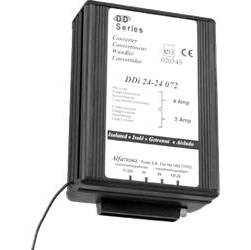
• Input voltage range: 24Vdc (+/- 30%)
• Output voltage: 27,2Vdc (+15% / -20%)
• Maximum current: 3A (continuous)
• Galvanic isolation
• LED indication
• Switchmode design
• Power conversion efficiency: typically 85%
• Life time warranty


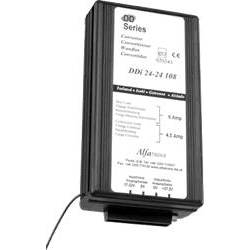
• Input voltage range: 24Vdc (+/- 30%)
• Output voltage: 27,2Vdc (+15% / -20%)
• Maximum current: 4,5A (continuous)
• Galvanic isolation
• LED indication
• Switchmode design
• Power conversion efficiency: typically 85%
• Life time warranty
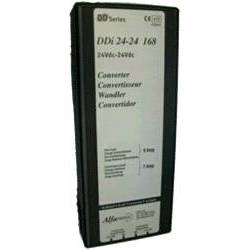
• Input voltage range: 24Vdc (+/- 30%)
• Output voltage: 27,2Vdc (+15% / -20%)
• Maximum current: 7A (continuous)
• Galvanic isolation
• LED indication
• Switchmode design
• Power conversion efficiency: typically 85%
• Life time warranty
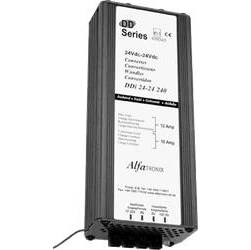
• Input voltage range: 24Vdc (+/- 30%)
• Output voltage: 27,2Vdc (+15% / -20%)
• Maximum current: 10A (continuous)
• Galvanic isolation
• LED indication
• Switchmode design
• Power conversion efficiency: typically 85%
• Life time warranty

What is a 24V voltage stabilizer, and what is its technical function?
The function of a 24V voltage stabilizer is to compensate for voltage fluctuations on the input side and ensure a constant, regulated 24V DC output. This is particularly important in systems where the stability of the supply voltage directly affects control accuracy and the reliability of data processing. The stabilizer operates with a continuous feedback control loop that corrects deviations in real time.
How does DC-DC converter-based voltage regulation work on a technical level?
Modern stabilizers use a switching DC-DC converter topology, typically in a buck, boost, or buck-boost configuration. The input voltage is converted using high-frequency switching cycles, and filter circuits ensure a low-ripple output signal. PWM control enables precise voltage regulation, while the system operates with high efficiency even under varying load conditions.
In which systems is a stabilized 24V power supply critical?
24V DC is widely used as an industrial standard, particularly in PLC-based control systems, industrial communication networks, and sensor-actuator systems. In these applications, the stability of the supply voltage directly affects signal transmission accuracy and the reliability of control cycles. Without a stabilizer, the system becomes susceptible to power grid disturbances and transient events.
Why is a stabilized output voltage critical in industrial environments?
The absence of a stabilized output voltage can cause significant electrical and operational problems. Both overvoltage and undervoltage can damage electronic components and cause malfunctions in digital systems. Using a voltage stabilizer minimizes noise, reduces ripple, and ensures deterministic operation.
What are the typical input voltage ranges and tolerances?
Professional 24V stabilizers support a wide input range, typically ranging from 9–36V or even 18–75V DC. This allows for use in environments with unstable power supplies, such as mobile systems or industrial networks. Regulators generally provide a tight output tolerance, often within the ±1–2% range.
How does overvoltage protection work from a technical standpoint?
Surge protection is typically implemented at multiple levels, including input transient protection and output surge limiting. The system detects critical voltage levels and, if necessary, shuts off the output or limits the voltage. This prevents damage to downstream devices.
What protection mechanisms does an industrial voltage stabilizer include?
Professional-grade devices employ integrated protection systems, which include short-circuit protection, overcurrent protection, and thermal protection. These functions automatically intervene in the event of abnormal operation, thus ensuring the integrity of the system. Thermal protection is particularly important under high loads and at high ambient temperatures.
What are the typical efficiency and loss characteristics of modern voltage stabilizers?
The typical efficiency of switch-mode stabilizers ranges from 90% to 95%, which significantly exceeds the performance of linear regulators. High efficiency results in lower heat loss, which reduces cooling requirements and extends the device’s service life. This is particularly important for systems operating continuously.
When is a DIN-rail mountable design recommended?
The DIN-rail compatible design is considered a standard solution in industrial control cabinets. This design enables quick installation, modular expandability, and seamless system integration. In addition to proper mechanical mounting, adequate heat dissipation is also ensured.
How do you select a stabilizer based on the appropriate technical parameters?
The primary considerations during selection are the input voltage range, the output current, and the load characteristics. In addition, efficiency, ripple, and protection features must be taken into account. We recommend always choosing a solution optimized for the specific application environment, as this ensures long-term stable operation.
What are the differences between entry-level and industrial stabilizers?
Entry-level devices often have limited protection functions and lower stability. In contrast, industrial stabilizers feature a robust design, better electromagnetic compatibility (EMC), and a wider operating range. This makes a significant difference in terms of reliability and service life.
What installation and operating conditions are required?
To ensure stable operation, proper heat dissipation, proper cabling, and compliance with load limits must be ensured. Improper installation can lead to overheating or unstable operation, so adhering to the manufacturer’s specifications is crucial.
What problems can arise from improper voltage regulation?
Improper regulation can result in voltage fluctuations, noise, and transients, which negatively impact system operation. This can lead to data loss, communication errors, or hardware damage. Using the appropriate voltage stabilizer is key to preventing these problems.
Where are 24V voltage stabilizers most commonly used?
24V stabilizers are widely used in industrial automation, transportation systems, security solutions, and telecommunications infrastructure. In these systems, a stable and uninterrupted power supply is an essential operating requirement.
Choose DND Telecom Center Kft. if you’re looking for a reliable, industrial-grade 24V voltage stabilizer, where precise technical specifications and continuous availability are standard. With us, you don’t just get a device—you also receive expert support to ensure you choose the solution that best fits your system.