

Fracarro Headend
A Fracarro headend receives, processes, and distributes satellite, terrestrial, cable, HDMI, analogue A/V, ASI, or IPTV signals. Its output can be a coaxial DVB-T/DVB-C multiplex, a multicast IPTV stream, or a signal forwarded through an optical network. The range includes GALAXIA, 3DGFLEX, and D-MATRIX systems. When selecting a configuration, we examine the required inputs, outputs, capacity, encrypted content handling, and expansion options. Read more...
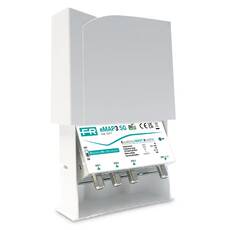
• Frequency band: 174-240 MHz/ 470-694 MHz
• Gain: 20 dB
• Automatic signal level control: above 60 dB dynamic range
• Number of inputs and outputs: 3 (VHF/ UHF) - 1
• VHF+UHF combined band: 174-240/ 470-862 MHz
• Output level (max.): 90 dBµV
• Group selective filter: 50 dB (per 1 MHz)
• Impedance: 75 ohms
• Connector: F type
• Dimensions: 120 x 105 x 60 mm

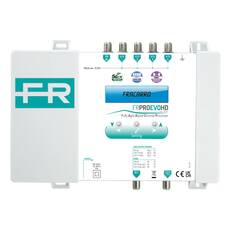
• Frequency band: 47-108/ 174-240/ 470-862 MHz
• Gain: 20 dB
• Automatic signal level control: above 75 dB dynamic range
• Number of inputs and outputs: 5 (1 VHF/FM + 4 VHF/ UHF) - 1
• VHF+UHF combined band: 47-108/ 174-240/ 470-862 MHz
• Output level (max.): 113 dBµV
• Group selective filter: 50 dB (per 1 MHz)
• Impedance: 75 ohms
• Connector: F type
• Dimensions: 170 x 216 x 50 mm

What is the role of a Fracarro headend in television signal processing?
A headend demultiplexes, remultiplexes, and rearranges received television services into a new channel plan, then forwards them as RF signals or IP streams. Fracarro transmodulation systems convert the input signal into the format required by the television receivers and the distribution network.
What does the central management of a Fracarro programmable headend provide?
GALAXIA uses a native full-IP web interface, while 3DGFLEX and D-MATRIX can be programmed and monitored locally or remotely through a web interface. Their USB ports can be used to save or load configurations, update firmware, and play video files in .TS format.
Fracarro headends for coaxial, IPTV, and optical networks
The systems can be used with coaxial, IPTV, and wideband optical networks. The two SFP ports of GALAXIA support optical connections up to 20 km. Of its four RJ45 GE ports, two are assigned to management and two to IP streaming. The system supports up to 120 IPTV input streams and 120 IPTV output streams in SPTS or MPTS format.
How does an IPTV encoder transmit multicast streams?
The GX-4HDMI-BP-R01 encodes four HDMI 1.4 inputs in H.264 HD/SD format. The GX-2IP-02 has two 10/100/1000 RJ45 ports, supports 128 input or output streams on Data 1 and 120 input or output streams on Data 2, and handles a maximum total bit rate of 700 Mbps. The 3DG-BP-IP OUT distributes up to 128 UDP or RTP/UDP multicast programmes with an effective bit rate of up to 1 Gbit/s, SAP and M3U service discovery, and SPTS and MPTS support. It handles UHD, HD, SD, and digital radio content and is ready for DRM integration.
What is the difference between GALAXIA, 3DGFLEX, and D-MATRIX?
How is the GALAXIA headend structured?
The GALAXIA GX-BOX-DP-SFP has a standard 19-inch, 1RU chassis with six module slots. The modules are hot-swappable, while the dual power supply provides redundant power. Received programmes can be shared between modules, and the chassis accepts satellite, DVB-T/T2, DVB-C, HDMI, Common Interface, IPTV, and DVB-T/DVB-C modules.
3DGFLEX headend with Smart and Pool backplane
The 3DG-BOX has six module slots, natural ventilation, and can be installed in a 4U rack or placed on the floor. A front plexiglass panel is included. Through the high-speed bidirectional Smart and Pool backplane, the modules share tuned channels, CAMs, and Smart Cards. Auto Remapping changes the channel plan without television retuning, while ARP 2.0 assigns priorities to individual programmes.
What capacity does the D-MATRIX compact headend provide?
The D-MATRIX-4S-4C converts programmes from four DVB-S2 transponders into four DVB-T or DVB-C multiplexes and includes two Common Interface slots. The D-MATRIX-8S-FTA provides eight FTA tuners and eight DVB-T multiplexes. The D-MATRIX-8S-8T includes eight tuners, two CI slots, and eight DVB-T multiplexes. Both models output up to 25 HD or 60 SD channels. The D-MATRIX-8S-IP operates with eight tuners, two CI slots, and up to 128 multicast IPTV streams. The series supports COFDM/QAM outputs and manages LCN, SID, PDSD, and NIT parameters.
Modular and compact Fracarro headends
Fracarro modular headend: features and design considerations
Advantages
Main characteristics:
- Mixed receiver, encoder, modulator, and IP modules.
- Six module slots in both GALAXIA and 3DGFLEX chassis.
- Local and remote web-based configuration.
- Programme sharing and redundant power supply options.
Capacity factors to consider
System sizing parameters:
- The required number of tuners and outputs within the six available module slots.
- The need for CI, FlexCAM, or PROCAM modules.
- The required ratio of RF and IPTV outputs.
- The fixed input and output structure of the selected D-MATRIX model.
Modular and compact designs provide different levels of expandability and fixed capacity.
How are DVB-S/S2/S2X, DVB-T/T2, DVB-C, and HDMI sources processed?
What does DVB-S2/S2X reception provide for satellite programmes?
The GX-4S2FTA-BP-01 has four independent DVB-S/S2/S2X FTA inputs with a separate LNB power supply for each input. The GX-4S2CI-BP-01 includes four tuners, two F connectors, and two PCMCIA Common Interface slots assignable to any tuner. The 3DG-4S2-4T converts four DVB-S2 inputs into four DVB-T/C outputs with remapping and remuxing. The 3DG-4S2-BP increases satellite reception capacity by four transponders. Its firmware is compatible with the DiSEqC SCD2 (dCSS) protocol.
How does DVB-T/T2 reception operate?
The GX-4T2CI-BP-00 tunes up to four DVB-T/T2 multiplexes from one RF input with an F connector and includes two assignable CI slots. The 3DG-4T2-4T converts four DVB-T2/C inputs into four DVB-T/C outputs with remapping, remuxing, or signal regeneration. The 3DG-4T2-BP increases terrestrial reception capacity by four multiplexes.
DVB-C reception with Common Interface management
The GX-4C2CI-BP-00 tunes up to four DVB-C Annex A/C multiplexes from one RF input with an F-female connector and includes two PCMCIA Common Interface slots assignable to any tuner. The GX-2CI-BP-00 adds two PCMCIA Common Interface slots that can be assigned to receiver modules.
Transmodulation, remultiplexing, and IPTV streaming
How does a DVB-T/C transmodulator operate?
The 3DGFLEX satellite, terrestrial, and ASI transmodulators manage four DVB-T/C outputs. The 3DG-4ASI-4T converts ASI signals into four DVB-T/C outputs with remapping, remuxing, and Smart and Pool channel sharing. The D-MATRIX Ad Hoc Mux function creates customised multiplexes from selected programmes received through different inputs.
Digital multi-modulator for DVB-T and DVB-C outputs
The GX-BP-8T-R01A generates up to eight DVB-T multiplexes through one RF output. The GX-BP-16T-16C generates up to sixteen DVB-T or DVB-C multiplexes through one RF output.
What reception, modulation, and Common Interface options are available?
FTA programmes can be processed without decryption. For encrypted content, GALAXIA supports Common Interface or PROCAM multi-decrypt modules, 3DGFLEX uses FlexCAM, and D-MATRIX works with CAMs and professional Smart Cards. The SIG7404H encodes up to four analogue A/V sources in MPEG-2 format and provides an ASI output. The SIG7804H264RFIP encodes up to four HDMI sources in H.264 format and provides simultaneous DVB-T RF and multicast IPTV outputs. SIG encoders include a front-panel keyboard, an integrated web interface, and a standard 19-inch, 1RU rack-mountable chassis.
Remote management, configuration, and service continuity
GALAXIA uses a dual power supply. The 3DG-PS-BU distributes power across the modules during normal operation and takes over if the main power supply fails. 3DGFLEX modules can play .TS files stored on a USB flash drive. In D-MATRIX systems, ARP 2.0 maintains priority programmes during multiplex bit-rate overflow and automatically restores the remaining programmes when the total bit rate returns to its operating range.
In which institutional systems can Fracarro headends be used?
Documented application environments include hotels, resorts, campsites, schools, university campuses, hospitals, prisons, ships, and institutional buildings. External HDMI or analogue sources can include information channels, decoders, computers, media players, or CCTV signals for distribution through coaxial or IPTV networks.
Frequently asked questions about Fracarro headends
- How many modules can GALAXIA and 3DGFLEX accommodate?
Both systems can accommodate up to six modules. - Can RF and IPTV outputs be used in the same system?
Yes. GALAXIA supports mixed configurations, while the SIG7804H264RFIP provides simultaneous DVB-T RF and multicast IPTV outputs. - What is the IPTV capacity of GALAXIA?
It supports up to 120 input streams and 120 output streams in SPTS or MPTS format. - Can encrypted television services be processed?
Yes, with the appropriate CI, CAM, FlexCAM, or PROCAM module and a professional Smart Card. - Can the channel plan be changed without retuning the televisions?
Yes, with the Auto Remapping function available in 3DGFLEX and D-MATRIX systems.
Conclusion: overview of Fracarro headend systems
GALAXIA is a modular 1RU system, 3DGFLEX is an expandable 4U system, and D-MATRIX is a compact system with a fixed configuration. We recommend defining the required inputs, output network, number of multiplexes or streams, and encrypted programme handling before selecting the system.