

Swiss Radar Radars
The Swiss Radar marine radar category is based on the Precision Navigator II system, which combines radar, Inland AIS functions and ECDIS chart display in a single device. The system offers three directly selectable operating modes: RADAR, MAP and ECDIS. RADAR mode displays the radar image, MAP mode displays the chart, while ECDIS mode overlays radar echoes and the ECDIS chart. AIS objects can be displayed in all three modes. Read more...

• River radar navigation system with built-in Inland AIS support
• AR 6 antenna, 1800 mm long, 4 kW peak power
• Direct selection of RADAR and MAP modes
• Display of Inland AIS objects and editing of user-defined AIS data
• 19-inch TFT display, 1024 × 1280 pixel resolution
• Six NMEA interfaces, three analog interfaces, and USB export
• 9410 MHz ±30 MHz X-band radar
• The package includes an alphanumeric keyboard

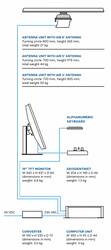
• A special cable for connecting the antenna to the central unit
• Available in the length you need

Swiss Radar marine radar: radar, Inland AIS and ECDIS in one system
The Precision Navigator II uses SyncPlot technology to update radar echoes and the stored chart simultaneously in ECDIS mode. The system features a 19-inch TFT display with a resolution of 1024 x 1280 pixels and five day and five night colour combinations. Monitor brightness can be adjusted with the rotary control on the operating unit. Basic radar functions include AUTO TUNE, radar image offset of up to 50 percent, navigation lines, VRM and EBL.
What does the Precision Navigator II navigation radar offer?
The system is available in BASIC, STANDARD and ECDIS versions. The BASIC version provides RADAR mode and the basic radar functions. The STANDARD version adds NMEA interfaces, Inland AIS connectivity, AIS object display, AIS message transmission and reception, and editing of own AIS data. The ECDIS version includes ECDIS and MAP modes, SyncPlot technology, access to chart information, and the ability to create chart objects and annotations.
Radar antenna, radar display and radar range
The X band (3 cm) transceiver operates at 9410 MHz +/- 30 MHz with a peak power of 4 kW and a 60 MHz intermediate-frequency receiver. AR 6, AR 7 and AR 9 antennas are available with turning-circle diameters of 1800, 2100 and 2700 mm respectively. Horizontal beamwidth is 1.2, 1.05 and 0.8 degrees respectively, vertical beamwidth is 20 degrees, and rotation speed is 28 revolutions per minute. Selectable radar ranges extend from 0.2 km to 64 km with several intermediate range settings.
- VRM: 0-130 km.
- EBL: 0-360 degrees with 0.1-degree resolution.
- Persistence mode: adjustable from 1 to 40 antenna revolutions.
- Measurement functions: distance, bearing and speed.
- Digital filters: Contrast, Contour, Clutter and Int. Rejection.
- Protection rating: antenna unit IP56, display system IP20.
The permitted average ambient operating temperature is 0 C to +40 C for the display system and -20 C to +55 C for the antenna unit. The specified non-operating temperature range is -35 C to +70 C. The system can be operated from 24 V DC or 230 V AC power.
How do radar detection and radar target tracking work?
The Clutter Filter compares radar information from multiple antenna revolutions. Echoes that have not appeared continuously during previous antenna revolutions are displayed with reduced intensity when filtering is active. Active echo detection and Target Tracking retain echoes that have been detected and tracked over multiple antenna revolutions without filtering them out. The Clutter Filter has three states: OFF, ON Level 1 and ON Level 2, and requires reliable compass and rate-of-turn data.
When the Contrast filter is enabled at the same time, reduced-intensity echoes can be hidden. A limitation of this combination is that rapidly moving objects detected only briefly may be classified as clutter, meaning they may not be displayed when Clutter and Contrast are used together. The Clutter Filter is available from the STANDARD version onwards and can also be made available on certain previously installed PN II units through a software update.
Inland AIS, ECDIS and vessel navigation
Inland AIS objects can be displayed in RADAR, MAP and ECDIS modes, while the object list provides detailed AIS information. The system supports sending and receiving AIS messages and allows direct editing of own AIS data. Supported devices include Saab R4, ComNav Voyager X3, Oceansat, L-3 Protec W, Furuno FA 150, SRT Poseidon and Transas AIS-M3. The STANDARD and ECDIS versions include six NMEA interfaces, a dedicated AIS input and output, and three analogue interfaces.
Position Prediction uses two lines to indicate the vessel's predicted path if heading and speed remain unchanged. Compass and rate-of-turn data are required for the calculation. Prediction time can be selected between 0 and 300 seconds, while the damping value changes how sensitively the calculation reacts to measured data. Wind, drift and other disturbing influences can cause deviations from the displayed predicted path.
Which optional navigation radar functions are available?
Route, TrackPilot and MOB functions are available as separately purchasable options for the ECDIS version. The Route function can import routes in GPS Exchange format and export them to a USB device, while routes can also be created and edited in MAP mode. A permitted route deviation can be defined, and exceeding this value triggers an alarm. A recorded track can be converted into a route using the Track function, while the argoTrackPilot connection can transfer the selected route to the TrackPilot system.
The MOB function stores the current GNSS position as a marker, which is displayed in ECDIS and MAP modes. Up to 10 markers can be stored, and their position and time can be displayed in tabular form. Blackbox Recording provides continuous event recording, and recordings can be exported to a USB device. Screenshots can also be captured, with internal memory capable of storing up to 1000 images.
Advantages:
- RADAR, MAP and ECDIS displays can be handled within the same system.
- Inland AIS objects can be displayed in multiple operating modes.
- The device can record screenshots and Blackbox recordings with USB export.
Limitations: Route, TrackPilot and MOB are separately purchasable options for the ECDIS version. The Clutter Filter requires reliable compass and rate-of-turn data for correct operation. When Clutter and Contrast are used together, rapidly moving objects detected only briefly may not be displayed.
Summary: Precision Navigator II Swiss Radar marine radar
The PN II in this category combines the radar image, Inland AIS data and, in the ECDIS version, chart display within a common operating environment. The three operating modes, multiple antenna options, digital radar filtering, Position Prediction, and optional Route, TrackPilot and MOB functions allow different system configurations to be defined. The required version, antenna size, AIS and ECDIS requirements, and optional functions should therefore be specified separately when selecting a configuration.
What are the most common questions about Swiss Radar marine radar?
- Which operating modes are available?
RADAR, MAP and ECDIS modes are available. MAP and ECDIS functions are associated with the ECDIS version. - What is the radar range?
Selectable range settings extend from 0.2 km to 64 km. - Can Inland AIS objects be displayed?
Yes. In the STANDARD and ECDIS versions, AIS objects can be displayed in RADAR, MAP and ECDIS modes. - What is the purpose of the Clutter Filter?
It compares data from multiple antenna revolutions and reduces the intensity of echoes that are not detected continuously, while tracked relevant echoes remain displayed without filtering. - Are route management and MOB functions available?
Yes, but they are separately purchasable options for the ECDIS version.