

- Special Offers
- Transceiver Radio
- Transceiver Accessory
- Antennas
- HF Antennas
- CB Antennas
- VHF Antennas
- Airband Antennas
- Marine Antennas
- UHF Antennas
- TETRA Antennas
- Multiband Antennas up to 500Mhz
- LoRa Antennas
- GSM Antennas
- WiFi Antennas
- Multiband Antennas from 500Mhz
- GPS Antennas
- Vehicle Antennas
- TV Antennas
- Parabola Antennas
- Triax Satellite Dish
- Amiko Parabola Antennas
- Televes Satellite Antenna
- Fracarro Satellite Dish
- Radio Broadcast Antennas
- Antenna Accessory
- Fiber Optics
- Cable
- Connector
- Installation Material
- Installation Tools
- Measuring Equipement
- Body Worn Camera
- Electrosmog
- Telephone
- Baby Monitor
- Fever Thermometer
- Radio Device
- Set-top Boxes
- Personal Protective Equipment
- Motorcycle Helmet Speaker
- Car Equipment
- Voltage Converter
- Dry Cell
- Battery
- Battery Charger
- Emergency Signal
- Amber Signal
- Sound Signal
- Light and Sound Signal Accessory
- Traffic Engineering
- LED Lamp
- Smart Home
- Mosquito Repellent Device
- Market - Other Products
- Discontinued Products
Pre-order (1)
Triax Satellite Dish
The Triax satellite dish category includes the TDS 80A 80 cm steel offset satellite antenna. The model is designed for the 10.7-12.75 GHz frequency range, has reflector dimensions of 845 x 745 mm and an offset angle of 25 degrees. The TDS 80A uses a RAL 7012 steel reflector, an aluminium arm, a galvanised steel rear mounting structure and a plastic LNB holder for 40 mm diameter LNBs. Its two mast clamps are suitable for poles with a diameter of 32-76 mm. Read more...
Pre-order (1)
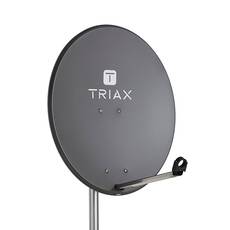
• 80 cm steel RAL dark gray high gain antenna
• Frequency range: 10.7 - 12.75 Ghz
• Aluminum arm with cable feed-through
• Gain: 37 dBi - 37.1 dBi
• Offset angle: 25
• Dish size: 845 mm x 745 mm
• Elevation angle: 15-56
• Wind load: 72 km/h / 144 km/h / 216 km/h: 17 kg / 69 kg / 156 kg
• Galvanized steel rear mounting and plastic LNB holder
• Two mast mounts for pole sizes 32-76 mm
• Custom packaging
• Color: gray


Triax satellite dish: TDS 80A technical specifications
What frequency range and antenna gain does the Triax TDS 80A provide?
The TDS 80A has a frequency range of 10.7-12.75 GHz. Antenna gain is frequency-dependent: 37.0 dB at 10.75 GHz, 38.1 dB at 11.75 GHz and 39.1 dB at 12.75 GHz. The cross polarisation value is greater than 27 dB and the F/D ratio is 0.6. The beamwidth specified at 12.75 GHz is less than 2.2 degrees.
- 10.75 GHz: 37.0 dB gain.
- 11.75 GHz: 38.1 dB gain.
- 12.75 GHz: 39.1 dB gain.
- Cross polarisation: greater than 27 dB.
- F/D ratio: 0.6.
Offset antenna reflector and adjustment range
How can the Triax satellite antenna be adjusted?
The TDS 80A offset reflector measures 845 x 745 mm and has an offset angle of 25 degrees. The elevation angle can be adjusted between 15 and 56 degrees. The maximum elevation angle specified for installation with clearance behind the pole is 42 degrees. The aluminium arm includes cable routing, allowing the coaxial cable to be guided through the arm.
Steel reflector, LNB holder and antenna mounting bracket
What mechanical construction does the TDS 80A satellite dish use?
The reflector is made of steel and finished in RAL 7012. The rear mounting structure and AZ/EL unit are made of galvanised steel, while the antenna arm is aluminium. The plastic LNB holder is designed for a 40 mm diameter LNB. Two mast clamps are suitable for poles with a diameter of 32-76 mm.
What is the wind load of the Triax TDS 80A?
Mechanical load specifications of the satellite reception system
The wind load of the TDS 80A is specified at three reference wind speeds. The value is 17 kg at 72 km/h, 69 kg at 144 km/h and 156 kg at 216 km/h.
- 72 km/h: 17 kg.
- 144 km/h: 69 kg.
- 216 km/h: 156 kg.
What packaging data is specified for the Triax satellite dish?
Triax antenna product number and packaging
The manufacturer product number of the TDS 80A is 126508 and its EAN is 5061038081237. The product is individually packed, with one unit per package. The package dimensions are 784 x 1000 x 99 mm.
Triax satellite dish FAQ
Satellite reception: frequently asked questions about the TDS 80A
- What is the frequency range of the Triax TDS 80A?
10.7-12.75 GHz. - What are the dimensions of the satellite dish reflector?
845 x 745 mm. - What size LNB can be used with the holder?
The plastic LNB holder is designed for a 40 mm diameter LNB. - What pole diameter can be used for mounting?
The two mast clamps are suitable for poles with a diameter of 32-76 mm. - What is the offset angle?
25 degrees. - What is the gain at 12.75 GHz?
39.1 dB.
Summary: Triax TDS 80A satellite antenna
Triax satellite dish with 80 cm steel reflector
The Triax TDS 80A is an offset antenna covering the 10.7-12.75 GHz frequency range, with an 845 x 745 mm steel reflector. Its aluminium arm includes cable routing, and it has a 40 mm plastic LNB holder and two mast clamps suitable for 32-76 mm poles. Antenna gain ranges from 37.0 dB to 39.1 dB at the three specified reference frequencies, while the elevation angle is adjustable between 15 and 56 degrees.