

- Special Offers
- Transceiver Radio
- Transceiver Accessory
- Antennas
- Antenna Accessory
- Fiber Optics
- Cable
- Connector
- Installation Material
- Installation Tools
- Crimping and Blanking Plier
- Cable Stripper
- Cutting-plier
- Tool Kit
- Cable Extension and Distribution Set
- Cable Reel Extension Set
- Power Distribution
- Soldering Station
- Measuring Equipement
- Body Worn Camera
- Electrosmog
- Telephone
- Baby Monitor
- Fever Thermometer
- Radio Device
- Set-top Boxes
- Personal Protective Equipment
- Motorcycle Helmet Speaker
- Car Equipment
- Voltage Converter
- Dry Cell
- Battery
- Battery Charger
- Emergency Signal
- Amber Signal
- Sound Signal
- Light and Sound Signal Accessory
- Traffic Engineering
- LED Lamp
- Smart Home
- Mosquito Repellent Device
- Market - Other Products
- Discontinued Products
Pre-order (0)
Power Distribution
A power strip allows multiple electrical devices to be connected to a single wall socket at the same time. When selecting the appropriate version, the number of sockets, cable length, switching method, intended environment and documented protection functions should be considered together. We recommend that you first count the devices you want to connect, then measure the required distance. Read more...
Pre-order (0)
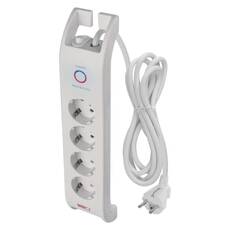
• Length: 2m
• Number of sockets: 4x 2P+PE
• Maximum current load: 16 A
• Power consumption: 900 J
• Maximum load: 3680 W
• With EMI/RFI filter
• With overvoltage indicator
• With connection indicator
• Frequency range: 150 kHz-100 MHz
• Attenuation: up to 40 dB
• Conductor: H05VV-F3G 1.5 mm²
• Dimensions: 342 × 66 × 50 mm
• Colour: white
• With child lock


What is a power strip and what is it used for?
A power strip converts one connection point into several usable sockets. A conventional version typically consists of a power cable, a mains plug and multiple socket outlets. It can be used in homes or offices to connect several devices to the same power source. It is not the same as a cable-free wall adapter that connects directly to the wall socket.
Switched power strips and versions without a switch
With a switched version, the power supply to the connected devices can be interrupted using a switch. Some models allow the sockets to be switched individually. On a power strip without a switch, every socket remains live while the strip is connected to the mains supply.
Which switching method suits your application?
- Advantage of a switched version: the connected devices can be disconnected without repeatedly unplugging their plugs.
- Limitation of a switched version: the number and operating method of the switches may differ between models.
- Advantage of a version without a switch: it has a construction with fewer operating controls.
- Limitation of a version without a switch: the connected devices cannot be disconnected from the strip using a switch.
A switched version can be used when frequent switching is required. We recommend that you check whether the model has one main switch or individually switched sockets.
The number of sockets determines how many devices can be connected
The number of socket outlets directly determines how many devices can be connected to the power strip. Available versions include groups with 2-3, 4-6, 8 or more sockets, as well as models with 3, 4, 5, 6, 8 or 10 sockets. Before making a selection, consider both the number of devices and their planned arrangement.
How many socket outlets do you need?
A 2-3 socket version can be used for a small number of devices and occupies less space. A 4-6 socket model allows several household or small-office devices to be connected simultaneously. A power strip with 8 or more sockets can be used for a larger number of devices, but it may require more installation space. A greater number of sockets does not mean that the strip can be loaded without limitation.
The maximum load may differ from one product to another. We recommend that you check the combined power demand of the connected devices in addition to the number of sockets.
Power extension cable length and positioning
The cable length determines the distance that can be covered between the wall socket and the connected devices. A shorter cable occupies less space and is less likely to become tangled. A longer cable provides more positioning options, but it may require more careful handling. The required distance should be measured in advance.
Why does the required cable length matter?
The cable should not be under tension and should not be placed where it can be damaged easily or create a tripping hazard. A longer cable may have greater electrical resistance, while unnecessary excess cable can be more difficult to manage. Select a length that reaches the intended position without creating an unnecessary length of loose cable.
Surge-protected power strips for sensitive electronic equipment
A conventional power strip does not usually include surge protection. A surge-protected power strip is intended to protect connected devices against overvoltage and voltage spikes. This type can be used with computers, televisions and audio equipment. The presence of surge protection must be checked for the specific product.
Which additional functions may be included in a power strip?
- USB port: may be used to charge USB-powered devices without a separate mains adapter.
- Wi-Fi connection: may allow remote control on certain models.
- Child protection: may be included as a safety function for the socket outlets.
- Thermal protection: may be included as an additional protection function on certain power strips.
- Surge protection: is intended to provide protection against voltage spikes.
These functions are not included on every model. When filtering the category, it is therefore useful to select the functions required for your application separately.
Advantages and limitations of power strips
The main advantage of a power strip is that several devices can be connected to a single wall socket. Different socket quantities, cable lengths and switching methods provide options for various equipment arrangements. A limitation is that increasing the number of sockets does not replace the need to check the maximum load, and a basic version does not necessarily include surge protection.
What should you check before making a selection?
- Count the devices that you want to connect at the same time.
- Measure the distance between the wall socket and the intended position of the power strip.
- Decide whether a main switch or individually switched sockets are required.
- Check for surge protection, child protection and thermal protection.
- Determine whether USB ports or Wi-Fi control are required.
- Check the maximum load in the technical description of the product.
Different constructions may be available for indoor, outdoor and industrial use. Use the power strip only in the environment specified for the product.
How should a power strip be used safely?
A power strip must be used for its intended purpose and within its specified load limits. Store it in a dry, protected location and inspect the cable, plug, sockets and housing. Replace the product if visible damage is found. Position the cable so that it is not stretched, damaged or likely to create a tripping hazard.
For outdoor use, select a version specifically designed for outdoor installation. In industrial environments, a power strip identified for that intended purpose must also be used. Always check the specified application and protection characteristics.
Frequently asked questions about power strips
- What is the purpose of a power strip?
It allows several electrical devices to be connected to a single wall socket. - What is the difference between switched and unswitched versions?
On a switched model, the power supply can be interrupted using a switch. On an unswitched power strip, the sockets remain live while the strip is connected to the mains supply. - How should I select the number of sockets?
Count the devices that will be used at the same time, then check the maximum load of the selected model. - Does every power strip include surge protection?
No. A conventional power strip does not usually include this type of protection. - Why is cable length important?
The correct cable length allows the power strip to reach the intended position without placing the cable under tension. - Which additional functions may be available?
Certain models may include USB ports, Wi-Fi connectivity, child protection, thermal protection or surge protection.
Functions and technical values differ between power strips. We recommend that you first filter by the number of sockets and cable length, then check the switching method, protection functions and maximum load.
Summary: selecting a power strip according to the application
The main selection criteria for a power strip are the number of sockets, cable length, switched or unswitched construction, and the required protection and control functions. Surge protection, USB ports, Wi-Fi connectivity, child protection and thermal protection should only be considered when they are included in the specific product. Before making a decision, also check the maximum load and the specified operating environment.