

Sirio TETRA Base Antenna
The Sirio TETRA base station antenna category includes base antennas designed for UHF radio communication around the 380 MHz range. The documented frequency ranges are 380-395 MHz, 395-410 MHz, and 380-406 MHz. The antennas in the category have an impedance of 50 ohm and a 360-degree omnidirectional radiation pattern. The available versions differ in antenna design, frequency range, gain, and maximum power, so these parameters should be considered together during selection. Read more...

• Type: 3/4λ coaxial J-pole
• Frequency range @ SWR ≤1.5: 380-395 MHz
• Impedance: 50Ω
• Radiation (H-plane): 360° omnidirectional
• Radiation (E-plane): beamwidth @ -3 dB = 60°
• Polarization: linear vertical
• Gain: 2 dBd, 4.15 dBi
• Max. Power (CW) @ 30°C: 250 Watts
• Grounding protection: All metal parts are DC-grounded, the inner conductor shows a DC short
• Connector: N-female
Special gross price: 41.46€ (Net price: 32.64€)


• Type: 3/4λ coaxial J-pole
• Frequency range @ SWR ≤1.5: 395-410 MHz
• Impedance: 50Ω
• Radiation (H-plane): 360° omnidirectional
• Radiation (E-plane): beamwidth @ -3 dB = 60°
• Polarization: linear vertical
• Gain: 2 dBd, 4.15 dBi
• Max. Power (CW) @ 30°C: 250 Watts
• Grounding protection: All metal parts are DC-grounded, the inner conductor shows a DC short
• Connector: N-female
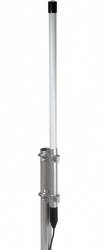
• Type: colinear
• Frequency range @ SWR ≤2: 380-406 MHz
• Impedance: 50Ω
• Radiation (H-plane): 360° omnidirectional
• Radiation (E-plane): beamwidth @ -3 dB = 14°
• Radiation angle: 0°
• Polarization: linear vertical
• Gain: 6 dBd, 8.15 dBi
• Max. Power (CW) @ 30°C: 75 Watts
• Grounding protection: All metal parts are DC-grounded, the inner conductor shows a DC-short
• Connector: N-female with rubber protection cap
Sirio TETRA base station antenna - main technical characteristics
The category includes both 3/4 Lambda and Colinear antenna designs. The 3/4 Lambda versions are specified for 380-395 MHz and 395-410 MHz, with 50 ohm impedance and a 360-degree omnidirectional radiation pattern. Their documented gain is 2 dBd, equivalent to 4.15 dBi, while the maximum power is 200 W.
Which frequency ranges are available in the TETRA antenna category?
Frequency range is one of the first parameters to check when selecting a TETRA antenna. The category includes 3/4 Lambda configurations for 380-395 MHz and 395-410 MHz, as well as a Colinear antenna specified for 380-406 MHz. Since these ranges partly differ, the operating frequency of the radio system should be compared directly with the specified antenna range.
Sirio antenna with 50 ohm impedance
All documented Sirio antenna configurations in the category have an impedance of 50 ohm. This value applies to the 380-395 MHz, 395-410 MHz, and 380-406 MHz versions. When configuring a radio communication system, both the antenna frequency range and the 50 ohm impedance should therefore be taken into account.
How do antenna gain and maximum power differ?
The documented gain depends on the antenna design. The 3/4 Lambda versions are specified with 2 dBd, equivalent to 4.15 dBi, while the Colinear design is specified with 6 dBd, equivalent to 8.15 dBi. Maximum power also differs: the 3/4 Lambda antennas are specified for 200 W, while the Colinear version is specified for 75 W.
UHF antenna with 2 dBd or 6 dBd gain
- 3/4 Lambda design: 2 dBd, equivalent to 4.15 dBi.
- Colinear design: 6 dBd, equivalent to 8.15 dBi.
- Maximum power of 3/4 Lambda versions: 200 W.
- Maximum power of the Colinear version: 75 W.
For a UHF antenna, gain and maximum power should not be considered separately. In this category, the Colinear version has the higher documented gain but a maximum power of 75 W, while the 3/4 Lambda versions have 2 dBd / 4.15 dBi gain and a maximum power of 200 W.
What radiation pattern is used by the base station antenna?
All base station antenna configurations in the category have a documented 360-degree omnidirectional radiation pattern. This characteristic is common to both the 3/4 Lambda and Colinear designs. The main differences therefore lie in the frequency range, antenna construction, gain, and maximum power rather than in the documented radiation pattern.
Fixed-mount antenna for TETRA radio systems
The category includes TETRA/UHF base station antennas for frequency ranges above 380 MHz. The 380-395 MHz, 395-410 MHz, and 380-406 MHz variants allow selection according to the operating frequency in use. All listed configurations have 50 ohm impedance and a 360-degree omnidirectional radiation pattern.
Radio communication and TETRA radio systems - what should be compared?
For radio communication and TETRA radio systems, the directly comparable parameters available in the category are frequency range, 50 ohm impedance, 360-degree omnidirectional radiation pattern, antenna construction, gain, and maximum power. These parameters distinguish the different 3/4 Lambda and Colinear solutions from one another.
What should be checked when selecting a Sirio TETRA base station antenna?
We recommend first determining the required frequency range, then checking the antenna design, 50 ohm impedance, gain, and maximum power. The 380-395 MHz and 395-410 MHz antennas have the same main electrical and structural characteristics but are designed for different frequency ranges. The 380-406 MHz Colinear configuration has different documented gain and maximum power values.
Sirio TETRA antenna selection checklist
- 380-395 MHz, 395-410 MHz, or 380-406 MHz frequency range.
- 3/4 Lambda or Colinear antenna design.
- 50 ohm impedance.
- 360-degree omnidirectional radiation pattern.
- 2 dBd / 4.15 dBi or 6 dBd / 8.15 dBi gain.
- 75 W or 200 W maximum power.
A single common gain or power value cannot be applied to all antennas in the category. The documented characteristics of the 3/4 Lambda and Colinear designs differ, so the parameters should always be assessed together.
FAQ - Sirio TETRA base station antennas
- Which frequency ranges are available?
The category includes antennas for 380-395 MHz, 395-410 MHz, and 380-406 MHz. - What is the impedance of the antennas?
The documented impedance of all listed configurations is 50 ohm. - What radiation pattern do they use?
The antennas in the category have a documented 360-degree omnidirectional radiation pattern. - What antenna gain values are available?
Depending on the antenna design, the documented gain is 2 dBd / 4.15 dBi or 6 dBd / 8.15 dBi. - What maximum power ratings are available?
The 3/4 Lambda configurations are specified for 200 W, while the Colinear configuration is specified for 75 W. - Which antenna designs are included in the category?
Both 3/4 Lambda and Colinear designs are included.
Summary
The Sirio TETRA base station antenna category includes UHF base antennas covering selected frequency ranges between 380 and 410 MHz. The documented configurations have 50 ohm impedance and a 360-degree omnidirectional radiation pattern. The 3/4 Lambda versions provide 2 dBd / 4.15 dBi gain with 200 W maximum power, while the Colinear design provides 6 dBd / 8.15 dBi gain with 75 W maximum power. Selection should therefore be based on the frequency range, antenna design, gain, and maximum power.