

Triax Compact Headend
The Triax compact headend receives satellite, terrestrial, cable and licence-dependent IP sources, then organises the TV and radio services into QAM, COFDM or IP outputs. The TDcH 22STC-I is designed for TV distribution in guest houses, hotels, office buildings and multi-dwelling buildings. The device combines 16 satellite tuners, 6 DVB-T/T2/C tuners, 8 CI interfaces and 16 switchable QAM or COFDM modulators. Read more...
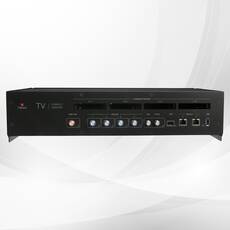
• Compact headend typically used for TV distribution in guesthouses, hotels, and office buildings
• Suitable for use in locations where cable TV is not available or the selection is insufficient
• Selection can be expanded with almost any channel from satellite sources
• 4 x SAT IF inputs with integrated multiswitch
• 1 x Terr / Cable input with integrated splitter
• 16 x DVB-S2 tuners, 6 x DVB-T/T2/C tuners
• 8 x CI interfaces
• 16 x QAM or COFDM full-band modulators


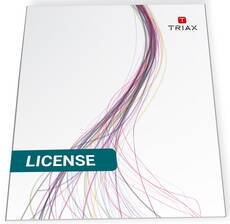
• An SFP adapter and IP-out activation license key are required to transmit IPTV signals from TDcH
• The license activates the IP-out function and is not based on the amount of service
• The maximum service capacity of a TDcH is 100 IP-out services (TV and radio) or a maximum output bandwidth of 950 Mbit
• Every TDcH headend can activate the IP-out function with a license key
What is a Triax compact headend and which TV distribution tasks can it perform?
The TDcH 22STC-I processes DVB-S, DVB-S2, DVB-S2X, DVB-T, DVB-T2 and DVB-C reception within a shared service pool. Services can be assigned to RF output transponders, CI modules or licensed IP outputs. Channel allocation, service names, EPG data and identifiers can be configured centrally.
The article number of the TDcH 22STC-I is 492782. The satellite section uses 4 SAT IF inputs with an integrated multiswitch, while the terrestrial or cable section uses 1 F connector input with an integrated splitter. The system supports SCR and DiSEqC 1.0 control.
TRIAX TDcH 22STC-I DVB-S/S2/S2X and DVB-T/T2/C signal processing
The 4 satellite inputs use 75 ohm F connectors and provide up to 400 mA LNB power per input. The reception frequency range is 950-2150 MHz, the input level range is 44-90 dBuV and the maximum data rate is 83 Mbit/s per tuner. Input selection supports DiSEqC 1.0, 13/18 VDC, 22 kHz and SCR control according to JESS.
The terrestrial or cable input has a frequency range of 47-862 MHz, an input level range of 40-95 dBuV and a channel bandwidth of 6, 7 or 8 MHz. DVB-T supports QPSK, 16QAM and 64QAM, DVB-T2 supports QPSK, 16QAM, 64QAM and 256QAM, while DVB-C supports 16QAM, 64QAM, 128QAM and 256QAM modulation. The DVB-C symbol rate is 1-7.2 MS/s.
Input services can be routed to any output, while the transport streams can be multiplexed according to the available output capacity.
How does the TDcH 22STC-I generate QAM or COFDM RF output?
The RF output is available through 1 x 75 ohm F connector, with a separate -20 dB test output. The output frequency range is 306-862 MHz and the channel range is S21-C69. The system processes 16 adjacent channels, and each channel can be switched off individually. The output level is electronically adjustable.
In QAM mode, the output level is 85-95 dBuV, the available modulation options are 16QAM, 32QAM, 64QAM, 128QAM and 256QAM, the symbol rate is 3.5-7.2 MS/s and the MER value is greater than 43 dB. In COFDM mode, the output level is 83-93 dBuV, the modulation is QPSK, 16QAM or 64QAM, the MER is at least 40 dB and the output mode is 2k.
TRIAX TDcH Service Pool technology, multiplexing and Transport Stream Processing
Service Pool technology processes TV and radio services received from different inputs as a shared service set. Multiplexing can be used for output transponders, CA modules, RF output and IP output. A complete and unchanged transponder can also be routed to a CAM or an output.
SID, TSID and ONID management can be used to handle identifier conflicts during multiplexing and to replace services. PID management can handle PID conflicts, perform PID filtering and transmit the same service with different language configurations. NIT, LCN, service names and EPG data can also be configured.
What is the purpose of the TDcH 22STC-I CI interface and CAM management?
The 8 front-panel CI interfaces accept CAM modules for centralised decryption. Supported CAM manufacturers include Aston, Neotion, SMARDTV and SMiT. Supported conditional access systems include Conax, Cryptoworks, Irdeto, Nagravision and Viaccess. The CI data rate can be set to 50, 72 or 96 Mbit/s, while the PID and service limits are determined by the CAM.
Service multiplexing also operates at the CA modules, allowing selected services to be assigned to a CAM. Real-time payload measurement at the CI interface, RF output and IP output monitors transport stream load and the presence of data.
IP input and IP output with SPTS/MPTS, UDP/RTP and licensing
The IP-in function requires an activation licence. The TDcH platform can use licences for 4, 16 or 96 SPTS/MPTS input streams. Reception takes place over IEEE802.3 Ethernet, a 1000 Base-T SFP interface or a Fibre SFP interface. SPTS and MPTS VBR streams can contain PAT, SDT, PMT, CAT and EIT tables. Multicast transmission uses UDP or RTP MPEG Transport Stream protocols.
The IP output transmits up to 100 SPTS streams with a total bit rate of 950 Mbit/s through the SFP interface. Supported functions include PID filtering and remapping, TTL values between 1 and 255, EIT data for the current service in the SPTS, and Samsung XML EPG. Supported Service Discovery protocols include M3U, M3Ue, M3Uepp and XSPF.
How is the Triax TDcH IP-out function activated?
Transmitting IPTV signals from the TDcH requires an SFP adapter and an IP-out activation licence key. The licence activates the IP-out function and is not linked to a specific number of services. The capacity limit is 100 IP-out TV or radio services, or a maximum output bandwidth of 950 Mbit/s.
TRIAX TDcH 22STC-I installation and operating data for 19-inch racks
The device can be installed in a 19-inch rack or mounted on a wall. The enclosure dimensions are 434 x 220 x 90 mm and the net weight is 4.1 kg. The permitted ambient temperature range is -10 to +50 C. The temperature-controlled cooling system uses integrated fans, and at least 4 cm of free ventilation space must be provided on both sides of the device.
The mains power supply range is 100-264 VAC at 50/60 Hz. The typical power consumption of the TDcH 22STC-I is 46 W, while the maximum power consumption is 90 W without CAM and LNB load. The earth terminal must be connected to the equipotential bonding system in accordance with EN 60728. The management interface is 1 x 1000 Base-T RJ45 port, and the web interface uses a self-signed HTTPS connection.
What are the advantages and limitations of the Triax compact headend?
Advantages of the TDcH 22STC-I:
- shared processing of satellite, terrestrial, cable and IP-based services
- integrated multiswitch and splitter with 16 switchable QAM or COFDM modulators
- centralised CI and CAM decryption with Service Pool, SID, TSID, ONID and PID management
- RF and licensed IP output with real-time payload measurement
The functions can be configured through a single web interface, and services can be replaced without retuning the connected TV sets.
Limitations of the TDcH system:
- the IP-in and IP-out functions require activation licences
- an SFP adapter is also required for IP-out operation
- the PID and service limits on the CI side are determined by the installed CAM
- earthing and at least 4 cm of ventilation space on both sides must be provided during installation
When planning the system, the input signal levels, modulation, output channel plan, CAM capacity and IP bandwidth must be determined together.
When can the TDcH 22STC-I be integrated into the planned system?
The device can be integrated with DVB-S/S2/S2X, DVB-T/T2/C or licensed IP sources, as well as QAM, COFDM or IP output networks. The compatibility of the CAM, channel plan, SFP interface and licence capacity must be checked during system planning.
FAQ about the TRIAX TDcH compact headend
- How many satellite and terrestrial or cable tuners does the TDcH 22STC-I contain?
The device contains 16 satellite tuners and 6 DVB-T/T2/C tuners. - Can the output be switched between QAM and COFDM?
Yes. The 16 full-band modulators can be configured for QAM or COFDM operation. - Does the basic headend include an IP-out licence?
IP-out requires a separate activation licence key and an SFP adapter. - How many IP output services can be transmitted?
Up to 100 SPTS services can be transmitted with a total bit rate of 950 Mbit/s. - Can the device be installed in a rack and mounted on a wall?
Yes. The TDcH can be installed in a 19-inch rack or mounted on a wall, with at least 4 cm of free space next to the ventilation openings.
Summary: Triax compact headend for TV distribution systems
The TDcH 22STC-I combines central processing of satellite, terrestrial, cable and licensed IP services with 16 QAM or COFDM RF modulators, 8 CI interfaces and up to 100 SPTS IP outputs. Before selection, we recommend checking the input sources, channel plan, decryption requirements, RF or IP output, required licences and SFP adapters together.