

Triax LNB Head
The Triax LNB range includes single, twin, quad, quattro, octo and DCSS models. The appropriate type is determined primarily by the number of satellite receivers to be connected and the design of the satellite distribution system. The range extends from models intended for a single receiver to a DCSS solution that supports up to 24 receivers over one coaxial cable. Read more...
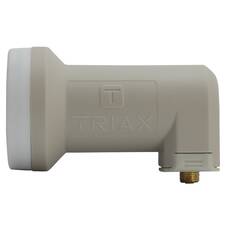
• Impedance: 75 Ω
• Input frequency lower band: 10.7-11.7 GHz
• Input frequency high band: 11.7-12.75 GHz
• Output frequency low band: 950-2150 MHz
• DC current consumption: 80 mA
• Dimensions: 95 mm x 64 mm x 57 mm
• Net weight: 0,076 kg
• Manufacturer's article number: 304871
• One indoor satellite receiver unit can be connected


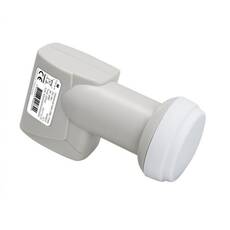
• Impedance: 75 Ω
• Input frequency lower band: 10.7-11.7 GHz
• Input frequency high band: 11.7-12.75 GHz
• Output frequency low band: 950-2150 MHz
• DC current consumption: 180 mA
• VSWR output2,0:1
• LNB type: double
• Dimensions: 130 mm (height) x 60 mm (width) x 80 mm (depth) x 40 mm (feedhorn diameter)
• Net weight: 0.208 kg
• Manufacturer's article number: 304 831 TTWD 006 / CS 320 T
• Suitable for connecting two indoor satellite receiver units
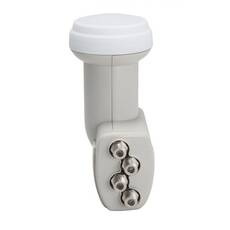
• Impedance: 75 Ω
• Input frequency lower band: 10.7-11.7 GHz
• Input frequency high band: 11.7-12.75 GHz
• Output frequency low band: 950-2150 MHz
• VSWR output: 2.0:1
• LNB type: Quad
• Dimensions: 130 mm (height) x 45 mm (width) x 80 mm (depth)
• Net weight: 0.213 kg
• Manufacturer's article number: 304 836 TQDD 006 / CS 404 QS
• Suitable for connecting four indoor satellite receiver units.
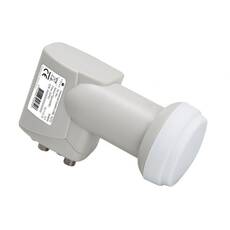
• Impedance: 75 Ω
• VSWR output: 2.0:1
• LNB type: Quattro
• DC Current consumption: 195 mA
• Input frequency low band: 10.7-11.7 GHz
• Input frequency high band: 11.7-12.75 GHz
• Output frequency low band: 950-2150 MHz
• Dimensions: 130 mm (height) x 45 mm (width) x 80 mm (depth)
• Net weight: 0.212 kg
• Manufacturer's item number: 304 850 TQTD 006 / CS 400 QT
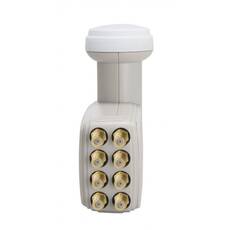
• Impedance: 75 Ω
• Noise max: type 0.3 dB
• LNB type: Octo
• Conversion gain (typ.): 55...65 dB
• DC current consumption: 190 mA
• LO frequency lower band: 9,75 GHz
• LO frequency high band: 10,6 GHz
• Dimensions: 142.88 mm (height) x 137.93 mm (width) x 59.21 mm (depth)
• Net weight: 0.350 kg
• Manufacturer's part number: 304 854 TOO 003 / CS 408 OS
• Capable of connecting up to eight indoor satellite receivers

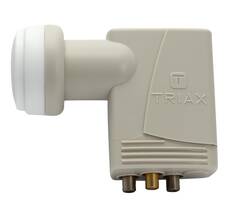
• High-quality and efficient DCSS with 2 universal outputs
• Manufacturer number: 304881
• Impedance: 75 ohm
• Advanced PLL technology - stable frequency, reliable reception
• Excellent cross-polarization suppression - low noise level and phase noise
• High gain
• Low power consumption
• Weatherproof design with sliding cover
• 24 user bands
Triax LNB models
The LNBs in this category have different numbers of outputs and are designed for different system configurations. The TSI 100 Gold single LNB is specified for one receiver, the CS 320 T twin LNB for two receivers, the CS 404 QS quad LNB for four receivers and the CS 408 OS octo LNB for eight receivers.
The CS 400 QT quattro is a separate model type. The number of receivers that can be connected directly to this model is not specified. The TDCSS 024 Gold DCSS LNB supports up to 24 satellite receivers in a single-cable system.
Which LNB should you choose based on the number of receivers?
The single, twin, quad and octo designations indicate how many satellite receivers the relevant Triax LNB can serve. Each connected receiver requires an appropriate LNB output.
- single LNB: for one satellite receiver;
- twin LNB: for two satellite receivers;
- quad LNB: for four satellite receivers;
- octo LNB: for eight satellite receivers;
- DCSS LNB: for up to 24 receivers over one coaxial cable.
When selecting a model, it is also worth considering the number of receivers that may be added to the system later.
Difference between quad and quattro LNBs
The terms quad and quattro are similar, but they refer to two different LNB designs. The CS 404 QS quad LNB is specified for four satellite receivers. The CS 400 QT quattro is a separate product type for which the number of directly connected receivers is not defined.
Both models have an input frequency range of 10.7-12.75 GHz and an output frequency range of 950-2150 MHz. Both versions have an impedance of 75 ohms, a feedhorn diameter of 40 mm and F-type connections.
DCSS LNB for single-cable satellite systems
The Triax TDCSS 024 Gold DCSS LNB allows up to 24 satellite receivers to be connected over one coaxial cable. The model provides 24 user bands, supports the EN50494 and EN50607 protocols and includes two universal Legacy outputs.
The DCSS design can be used in systems where satellite signals must be distributed to several receivers over the same coaxial cable. The unit uses PLL technology and has an input frequency range of 10.7-12.75 GHz and an output frequency range of 950-2150 MHz.
- connection of up to 24 satellite receivers;
- single-cable signal distribution;
- EN50494 and EN50607 protocols;
- 24 user bands;
- two Legacy outputs.
The operating temperature range of the TDCSS 024 Gold is from -30 to +70 C.
Frequency range and connection
The lower input frequency band of the Triax universal LNBs is 10.7-11.7 GHz, while the upper input frequency band is 11.7-12.75 GHz. The output frequency range is 950-2150 MHz. The local oscillator frequency is 9.75 GHz for the lower band and 10.6 GHz for the upper band.
The models use F-type connections. The documented feedhorn diameter of the single, twin, quad and quattro versions is 40 mm. The operating temperature range of the single, twin, quad, quattro and octo models is from -30 to +60 C.
Triax LNB selection criteria
The first step in selecting the appropriate model is to determine the number of satellite receivers to be connected. A single model can be selected for one receiver, a twin for two receivers, a quad for four receivers and an octo for eight receivers. For larger single-cable distribution systems, the DCSS version provides a documented solution with 24 user bands.
In addition to the system configuration, the connection type, 40 mm mounting diameter, operating temperature and supported protocols should also be checked. When using the DCSS model, compatibility with EN50494 and EN50607 must also be considered.
Summary
The Triax LNB range includes several designs for different satellite system configurations. The number of receivers determines the choice between single, twin, quad and octo models. The quattro is a separate design, while the TDCSS 024 Gold is a single-cable solution that supports up to 24 receivers and uses the EN50494 and EN50607 protocols.
Frequently asked questions about Triax LNBs
- How many satellite receivers can be connected to a single LNB?
One satellite receiver. - How many receivers are supported by twin and quad LNBs?
The twin model is specified for two receivers, while the quad model is specified for four receivers. - What is an octo LNB used for?
It is used to connect up to eight satellite receivers. - What is the difference between a quad and a quattro LNB?
The quad is specified for four receivers, while the quattro is a separate LNB design. - How many receivers does the TDCSS 024 Gold support?
It supports up to 24 satellite receivers over one coaxial cable. - Which protocols are supported by the DCSS LNB?
The EN50494 and EN50607 protocols.