

- Special Offers
- Transceiver Radio
- Transceiver Accessory
- Antennas
- Antenna Accessory
- Fiber Optics
- Cable
- Connector
- Installation Material
- Installation Tools
- Measuring Equipement
- Body Worn Camera
- Electrosmog
- Telephone
- Baby Monitor
- Fever Thermometer
- Radio Device
- Set-top Boxes
- Personal Protective Equipment
- Motorcycle Helmet Speaker
- Car Equipment
- Voltage Converter
- Dry Cell
- Battery
- Battery Charger
- Emergency Signal
- Amber Signal
- Sound Signal
- Light and Sound Signal Accessory
- Traffic Engineering
- LED Lamp
- Smart Home
- Mosquito Repellent Device
- Market - Other Products
- Discontinued Products
Ogniochron Powder Fire Extinguisher 1kg
(discontinued)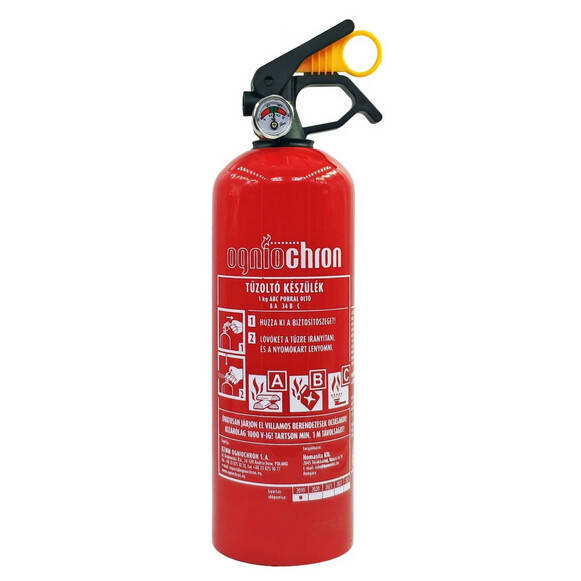
Key features of Ogniochron Powder Fire Extinguisher 1kg
• Type: ABC powder fire extinguisher (dry)
• Extinguishing agent: 1 kg ABC powder (effective against class A, B, and C fires)
• Propellant: Nitrogen
• Total weight: 1.7 kg
• Height: 288 mm
• Certification: Complies with EU and domestic regulations
• Operating time: approx. 6 seconds
• Operating temperature: between -30 and +60 degrees Celsius
• Production time: 12.2021 (lifespan of 20–25 years)
Possible reasons that the product is not available from the manufacturer anymore or we decided to remove it from our product portfolio. We gladly help you to find the best optional product instead of this type, please contact us.


Further details of Ogniochron Powder Fire Extinguisher 1kg
• Equipped with a pressure gauge
• Extinguishing capacity: 8A 34B C
• Can be used under max. voltage: up to 1000 V (maintaining a safe distance)
The OGNIOCHRON GP-1x ABC 1 kg powder fire extinguisher is a compact, universal extinguishing device filled with ABC extinguishing powder and equipped with a manometer (pressure gauge) for quick operational checks. It is ideal for cars, vehicles, workshops, garages, living spaces, or camping.
Fires are classified according to the nature of the burning material, because choosing the right extinguishing agent is essential for effective and safe extinguishing.
Class A fires include fires involving solid materials such as wood, paper, cardboard, textiles, or certain plastics. These fires typically smolder and can be extinguished with water, foam, or powder.
Class B fires include fires involving combustible liquids, such as gasoline, diesel fuel, oil, paint, and various solvents. These fires burn with flames and must not be extinguished with water, as water can spread the burning liquid. Foam, powder, or carbon dioxide-based extinguishing agents can be used to extinguish them.
Fire class C refers to fires involving combustible gases, such as natural gas, propane-butane, or hydrogen. These pose an increased risk of explosion, so the first step in extinguishing them is always to shut off the gas supply. Powder fire extinguishers are best suited for extinguishing such fires.
Class D fires include fires involving metals such as magnesium, aluminum powder, sodium, or potassium. These burn at extremely high temperatures and must not be extinguished with water or foam, as this can cause a serious reaction. They can only be extinguished with special metal extinguishing powder.
Class F fires refer to cooking oil and grease fires, which most commonly occur in kitchens. Extinguishing hot oil with water can cause an explosive flash, so only Class F extinguishing agents or fire blankets may be used for this purpose.
Fires involving electrical equipment do not constitute a separate fire class, but require special treatment. For live equipment, powder extinguishers or carbon dioxide extinguishers can be used, typically up to 1000 volts, while maintaining a safe distance. After de-energizing, the fire class corresponding to the burning material applies.
Knowledge of fire classes helps in selecting the appropriate fire extinguisher, increases the effectiveness of extinguishing, and significantly reduces the risk of accidents and material damage.